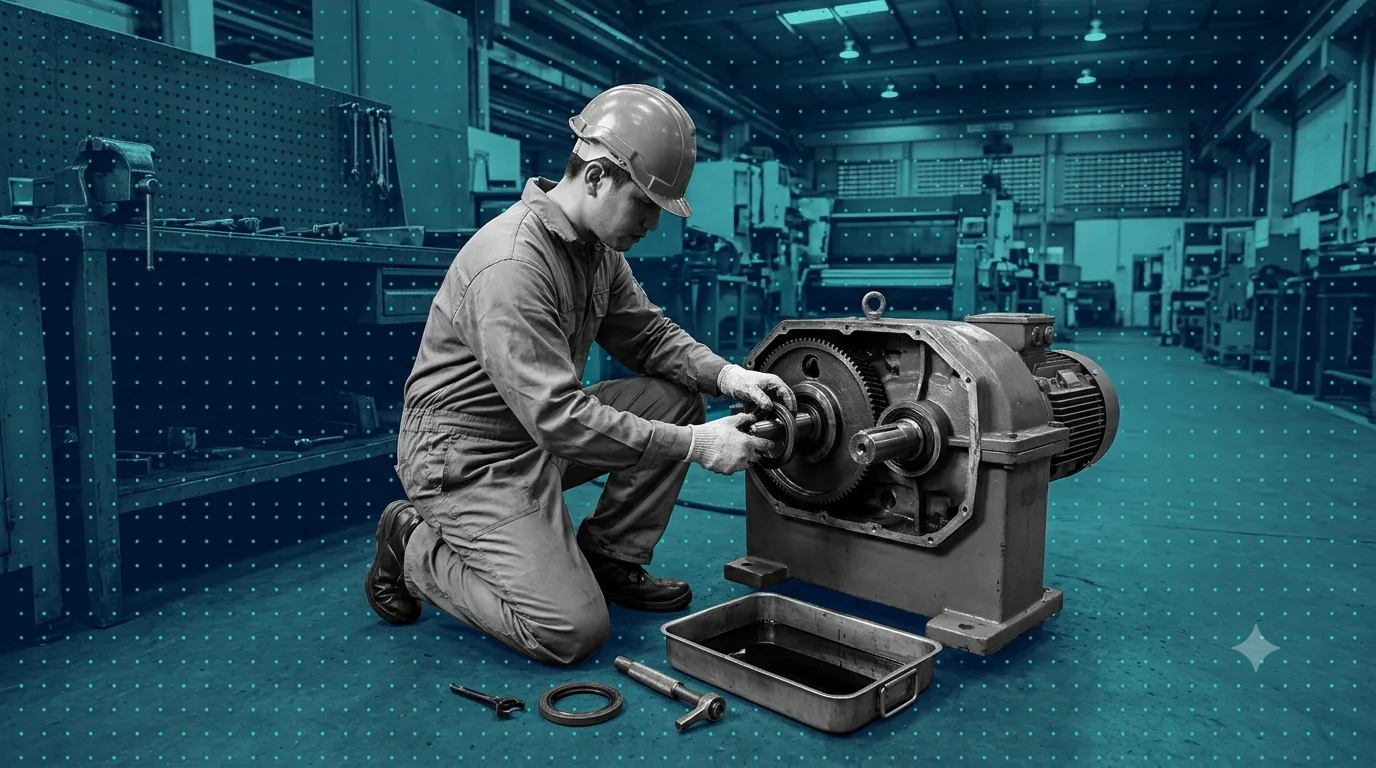



Preventive maintenance is maintenance done before a failure, at a set interval of time or use, to lower the chance the asset fails: lubricating a conveyor chain weekly, servicing a compressor at its run-hour interval, testing a safety interlock every quarter. It works on failures that are age- or wear-related. For failures that give a measurable warning, a scheduled inspection for that warning usually beats a fixed replacement.
Most maintenance teams run some preventive maintenance. Far fewer can say which failure each PM task is meant to stop, or whether it's stopping it. That gap is the difference between a PM program and a calendar full of chores.
This guide covers what preventive maintenance means (the term has two meanings, and the difference matters), the four kinds of PM task, plant examples, where PM works and where it doesn't, how to set up a program, and how to tell whether it's working. The how-to detail lives in our guides to the preventive maintenance schedule and the preventive maintenance checklist.
What preventive maintenance is
Preventive maintenance (PM) is work you do on purpose, before anything breaks, because experience or the manufacturer says the asset will fail if you don't. The machine is running fine. You stop it anyway, at a time you chose, to service, inspect, test or replace something.
The term gets used two ways, and most articles mix them up without saying so.
The broad meaning. The European standard EN 13306, which defines maintenance terms, treats preventive maintenance as everything done before failure to reduce its likelihood. It then splits that into two kinds:
- Predetermined maintenance: done at set intervals of time or use, without checking the asset's condition first.
- Condition-based maintenance: done because a check or measurement showed the asset needs it. Predictive maintenance sits inside this group, since it's condition-based work timed by a forecast.
The narrow meaning. In everyday plant language and in most CMMS software, preventive maintenance means the interval-triggered kind: time-based or usage-based work. Condition-based and predictive maintenance are treated as separate strategies.
Neither meaning is wrong. They just answer different questions. The broad one asks "did we act before the failure?" The narrow one asks "what told us to act?"
On this site, preventive means the narrow, interval-triggered kind. Condition-based and predictive maintenance have their own guides. If you read a source that lists "condition-based" or "predictive" as a type of preventive maintenance, it's using the broad meaning.
A few other terms you'll run into:
| Term | What it usually means |
|---|---|
| Predetermined maintenance | The EN 13306 name for interval-triggered PM |
| Time-based maintenance | PM on a calendar interval (weekly, monthly, yearly) |
| Usage-based or meter-based maintenance | PM on running hours, cycles, strokes or distance |
| Scheduled maintenance | Often a synonym for interval PM. Some people use it for any job with a date and an assignee |
| PPM (planned preventive maintenance) | A UK and facilities term for a PM schedule. See planned maintenance for how "planned" differs |
| Proactive maintenance | A philosophy, not a trigger: find and remove the causes of failure. PM is one part of it |
What triggers a PM: time or usage
Every preventive task needs a trigger, and there are two.
Time. Some things age whether the machine runs or not. Seals harden. Lubricant oxidizes. Filters in a dusty room load up on a calendar, not a run-hour count. Batteries in a standby system lose capacity sitting still. For these, a calendar interval makes sense.
Usage. Other things wear with running. Bearings under load, cutting tools, drive belts, compressor valves and anything counted in strokes or cycles wear with work done, not days passed. A machine running three shifts needs these tasks three times as often as one running a single shift, so a calendar interval will be wrong for one of them. Running hours or cycle counts track wear much better.
Condition-based work sits next to these two. Instead of acting at an interval, you check the asset at an interval and act only when the check finds something. It's covered in the schedule guide's types of PM scheduling and in the condition-based maintenance guide.
The four kinds of preventive task
Search for "types of preventive maintenance" and you'll get four different answers. There's no standard list. The most useful way to sort PM is by what the technician actually does:
| Kind of task | What it does | Plant examples |
|---|---|---|
| Inspect | Looks for a defect or an early warning sign | Belt wear, oil leaks, loose guards, hot spots, unusual noise |
| Service | Keeps the asset in its designed condition | Lubricate, clean, adjust, top up, replace filters and other consumables |
| Restore or replace | Overhauls or swaps a part at a fixed age, whether or not it looks worn | Rebuild a gearbox at a set hour count, replace a wear liner every year |
| Test | Proves a protective or standby device still works | Relief valves, safety interlocks, emergency stops, standby pumps |
Each kind earns its place differently:
- Inspections are the most useful PM tasks, because they find problems early. Most of what they find becomes corrective maintenance, fixed at a time you choose instead of at 2 a.m.
- Service tasks are the basics: lubrication, cleaning, tightening. Skip them and wear speeds up.
- Restore and replace tasks only make sense when there's evidence the part wears out at a predictable age. Without that evidence, you're replacing good parts and adding risk. See overhaul meaning for how overhauls fit.
- Tests matter for devices that you only need in an emergency. A relief valve that's seized shut looks exactly like a working one until the day the pressure rises.
If you know reliability-centered maintenance, these map loosely onto its task types: on-condition tasks, scheduled restoration, scheduled discard and failure-finding.
Preventive maintenance examples from the plant floor
Six common PM tasks, each tagged with its trigger and kind. The intervals come from the OEM manual and your own history, so none are given here as fixed numbers.
- Conveyor chain lubrication. Trigger: time (weekly, or as the manual says). Kind: service. A dry chain wears its sprockets and stretches early.
- Air compressor service at its run-hour interval. Trigger: usage. Kind: service, often done by the OEM's service contractor. Oil, filters, separator element and a valve check at the hours the manufacturer specifies.
- Press safety interlock test. Trigger: time (quarterly is common). Kind: test. Open the guard, confirm the press can't cycle, record the result.
- V-belt inspection on a fan or air handler drive. Trigger: time. Kind: inspect. Cracks, glazing and tension. A worn belt found here becomes a planned corrective job.
- Pressure relief valve test. Trigger: time (often annual, and often required by your insurer or local regulator). Kind: test.
- Cutting-tool change at a cycle count. Trigger: usage. Kind: replace. The tool is changed at a set number of parts, before it wears enough to cause scrap or a crash.
Equipment-specific programs follow the same pattern. Our forklift maintenance guide is one worked example.
When preventive maintenance works, and when it doesn't
PM is the right answer for some failures and the wrong answer for others. The question for each task is: how does this part actually fail?
It works when the failure is age- or wear-related. If a part wears out on a roughly predictable timeline, servicing or replacing it before then prevents the failure. Belts, filters, lubricant, brake pads, cutting tools and seals in hot service often behave this way.
It doesn't help when the failure is random. Many failures don't get more likely as a part gets older. Electronics and a lot of rolling bearings in normal service fail at random. Replacing them on a schedule doesn't lower the odds. You swap a part that would have kept running and still get failures between PMs. The reliability-centered maintenance guide covers the research behind this and the failure patterns it found.
When the failure gives a warning, inspect for the warning. If a bearing gets louder, hotter or rougher before it fails, a scheduled check for those signs catches it in time, without replacing healthy bearings. That's condition-based maintenance, and for many assets it beats a fixed replacement.
When the failure is hidden, test for it. A standby pump or a safety device can fail without anyone noticing, because nobody needs it until there's an emergency. The only defense is a periodic test that proves it still works.
When the failure is cheap, let it fail. For a non-critical asset that fails without damaging anything else, and with a spare on the shelf, deliberate run-to-failure is a valid choice. See breakdown maintenance for when that makes sense.
Too much PM: over-maintenance and maintenance-induced failures
More PM isn't always better. Every time someone opens up a machine, there's a chance they leave it worse than they found it.
Maintenance-induced failures are real. A seal disturbed during an inspection starts weeping a week later. A gearbox cover goes back on with uneven bolt torque. A bearing gets more grease than it needs and runs hot. A brand new replacement part turns out to be defective and fails early. Every one of these is a failure the PM caused.
PM on healthy equipment costs labor the backlog needs. Hours spent replacing parts that weren't worn are hours not spent on the corrective jobs your inspections already found.
The fix is to tie every task to a failure. For each PM task, you should be able to answer: which failure does this prevent, and how do we know it fails that way? Then:
- Cut tasks that don't prevent anything and never find anything.
- Replace intrusive tasks with inspections when the part gives a warning before it fails.
- Keep the basics (lubrication, cleaning, tightening) done properly, to the right amount, by people who know the equipment.
- Isolate the machine before any intrusive PM. A PM is planned work, so there's no excuse for rushing the lockout.
Program, plan, schedule, checklist: what's the difference
These words get used interchangeably, which makes PM advice hard to follow. Each one answers a different question:
| Term | The question it answers | Where to go next |
|---|---|---|
| PM program | Which assets, which failures, which tasks, who owns them, and how it's all reviewed | This guide |
| PM plan | What's the task set for this one asset? | PM schedule guide |
| PM schedule | When is each task due, across every asset? | PM schedule guide |
| PM checklist | How is each task done, step by step? | PM checklist guide |
| Work order | Did it get done, by whom, and what did they find? | Work order management |
A program without a schedule never happens. A schedule without a program is a list of chores nobody can justify. You need both.
How to set up a preventive maintenance program
Seven steps. Each links to the guide that covers it in depth.
- Rank your assets by criticality. What happens to production, safety and cost if each one fails? Start with the assets where the answer is worst. The schedule guide's first step shows a simple way to rank them.
- Write down how each critical asset fails. Use your breakdown history, the OEM manual and the people who fix it. You can't prevent a failure you haven't named.
- Pick a task for each failure, or decide to let it fail. Service, inspect, restore, replace or test, based on how the failure behaves. This is the core idea of reliability-centered maintenance.
- Set the trigger and interval. Start from the OEM manual, then adjust from your own history. Time for things that age, usage for things that wear.
- Write the checklist. Clear steps, pass/fail checks and what to record. See the PM checklist guide.
- Dispatch and record every PM as a work order. If it isn't recorded, you can't tell whether it was done or what it found. See work order management.
- Review it every quarter. What did the PMs find? What failed anyway? Which tasks never find anything? That's the next section.
Start with five critical machines, not the whole plant. A small program that runs and gets reviewed beats a big one that lives in a spreadsheet.
Is your PM program working? Compliance vs effectiveness
There are two different questions here, and most plants only measure the first.
Compliance: were the PMs done on time? PM compliance is PMs completed within their due window divided by PMs scheduled, as a percentage. It tells you whether the program is being carried out. The PM compliance calculator does the math.
Effectiveness: did the PMs prevent what they were meant to? Compliance can read 100% while breakdowns go up. That happens when the tasks don't match the way the assets fail, or when PMs get closed without the checklist actually being done. Four checks that don't need any benchmark:
- Breakdowns on assets that have PMs. For each one, ask whether the failure was one a PM task was supposed to prevent. If it was, the task, the interval or the way it's done is wrong.
- How often PM inspections find something. An inspection that finds problems is doing its job. A task that hasn't found or prevented anything in a year is a candidate to stretch or cut.
- The MTBF trend on assets with PMs. If the program works, time between failures should rise. See MTBF and the MTBF calculator.
- PMs deferred, and why. A PM pushed back once is a decision. A PM pushed back every month is a risk nobody owns. See deferred maintenance.
Schedule compliance and planned maintenance percentage add context, but none of these numbers replace the first question: is the failure we were trying to prevent still happening?
Preventive vs corrective, breakdown, condition-based, predictive and planned maintenance
| Type | What triggers the work | When the work happens | Guide |
|---|---|---|---|
| Preventive | A time or usage interval | Before failure, at the interval | This guide |
| Corrective | A fault found, often by a PM inspection | After the fault is found, now or at a planned stop | Corrective maintenance |
| Breakdown | The asset fails | Immediately, unplanned | Breakdown maintenance |
| Condition-based | A check or reading crosses a limit | When the condition says so | Condition-based maintenance |
| Predictive | A forecast from condition data | Before the forecast failure | Predictive maintenance |
Preventive and corrective aren't opposites. PM inspections create corrective work, and that's the point of them. A fault found on a route and fixed at the next planned stop is the program working.
For the head-to-head comparison with breakdown work, see breakdown vs preventive maintenance. For how all of these fit together, see the types of maintenance overview.
Planned is a different axis. It describes how a job was prepared, not what triggered it. Most PM tasks are planned, but a corrective repair can be planned too. The planned maintenance guide covers the difference.
In total productive maintenance (TPM), operators take on the simplest PM tasks (cleaning, basic checks and lubrication) under the autonomous maintenance pillar, and the maintenance team keeps the rest.
Benefits and drawbacks of preventive maintenance
What PM gets you:
- Fewer age- and wear-related failures.
- Downtime moved into windows you choose, instead of the middle of a production run.
- Predictable labor and parts needs, so the maintenance planner can prepare jobs properly.
- A record of what was done and when, for audits, insurers and warranty claims.
What it costs:
- Labor spent on equipment that didn't need it, when the tasks don't match how the asset fails.
- Maintenance-induced failures from disturbing healthy equipment.
- No protection against random failures.
- A schedule that grows faster than the team, until PMs start getting skipped.
The drawbacks all come from the same place: tasks chosen by habit instead of by failure mode. Fix the task list and most of them go away.
Where a CMMS helps
A CMMS won't decide which tasks your assets need. That's still the job of the people who know the equipment. What it does is make sure the tasks you've decided on actually happen, and keep the record you need to judge whether they're working.
In MachDatum, PM plans run on recurrence schedules built on an iCal engine, so complex calendars like "every second Tuesday" or "the first weekday of each quarter" work. On the due date, auto-dispatch creates the work order and assigns it, with the checklist pre-attached and the asset linked. Checklists are versioned, and every closed PM records exactly which version was followed, which is useful when an auditor asks how a task was done last March.
Overdue PMs show up in the PM list straight away. Due-date reminders and escalation rules pull in the plant manager or department head when a job slips past its threshold. Completed PMs, and the corrective jobs they raise, land in the asset's history, with root cause, failure mode and downtime captured on the work order. MTBF, MTTR and downtime by asset come straight from that work order data, which is what the effectiveness checks above need.
If your CNC machines are monitored with ThingConnect, MachDatum's sister product, a condition signal or a tool reaching end of life can open the job in MachDatum instead of waiting for the calendar.
We're onboarding our first group of manufacturing teams. If your PM program lives in a spreadsheet and a wall planner, see how MachDatum CMMS handles PM plans, checklists and work orders.