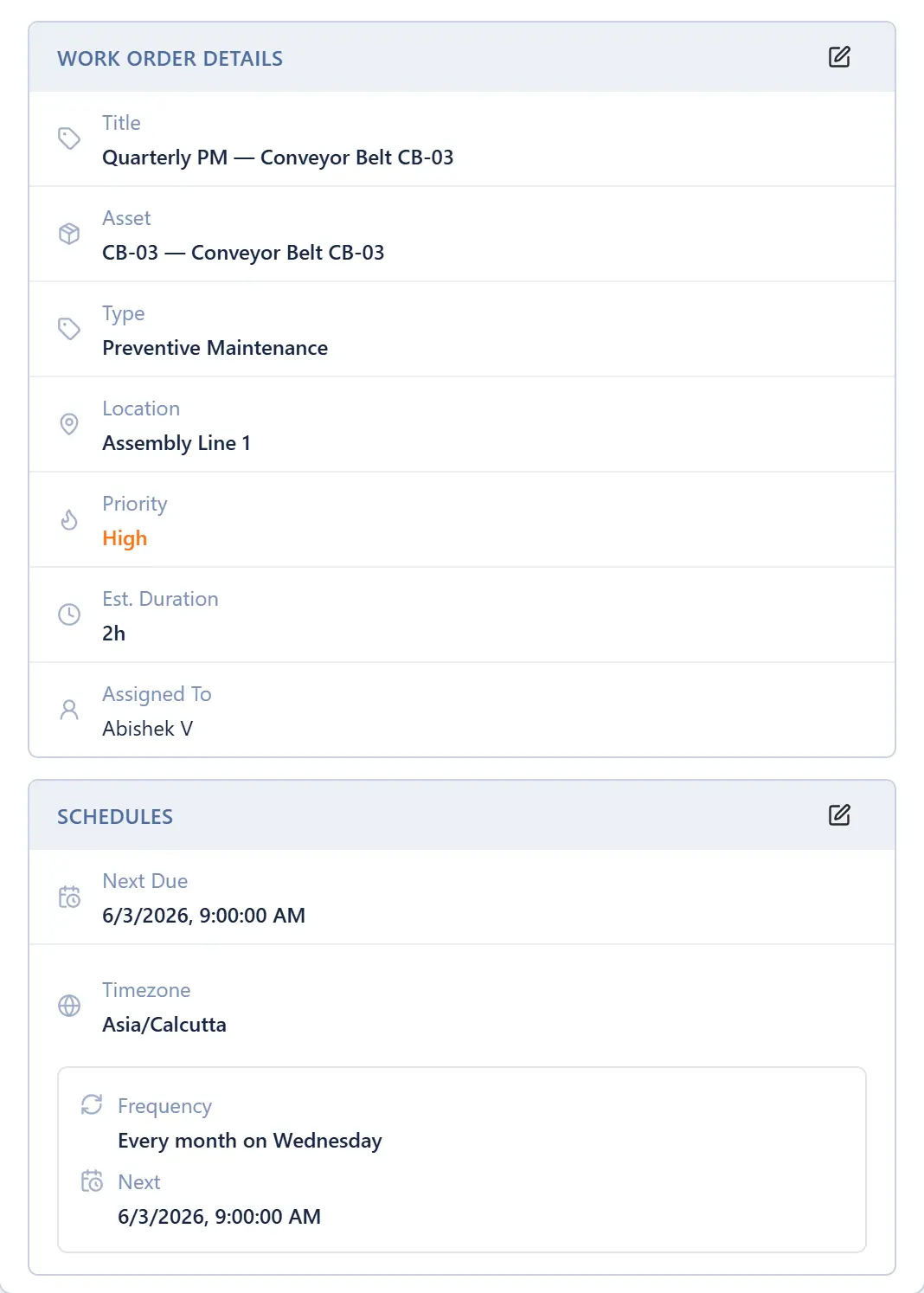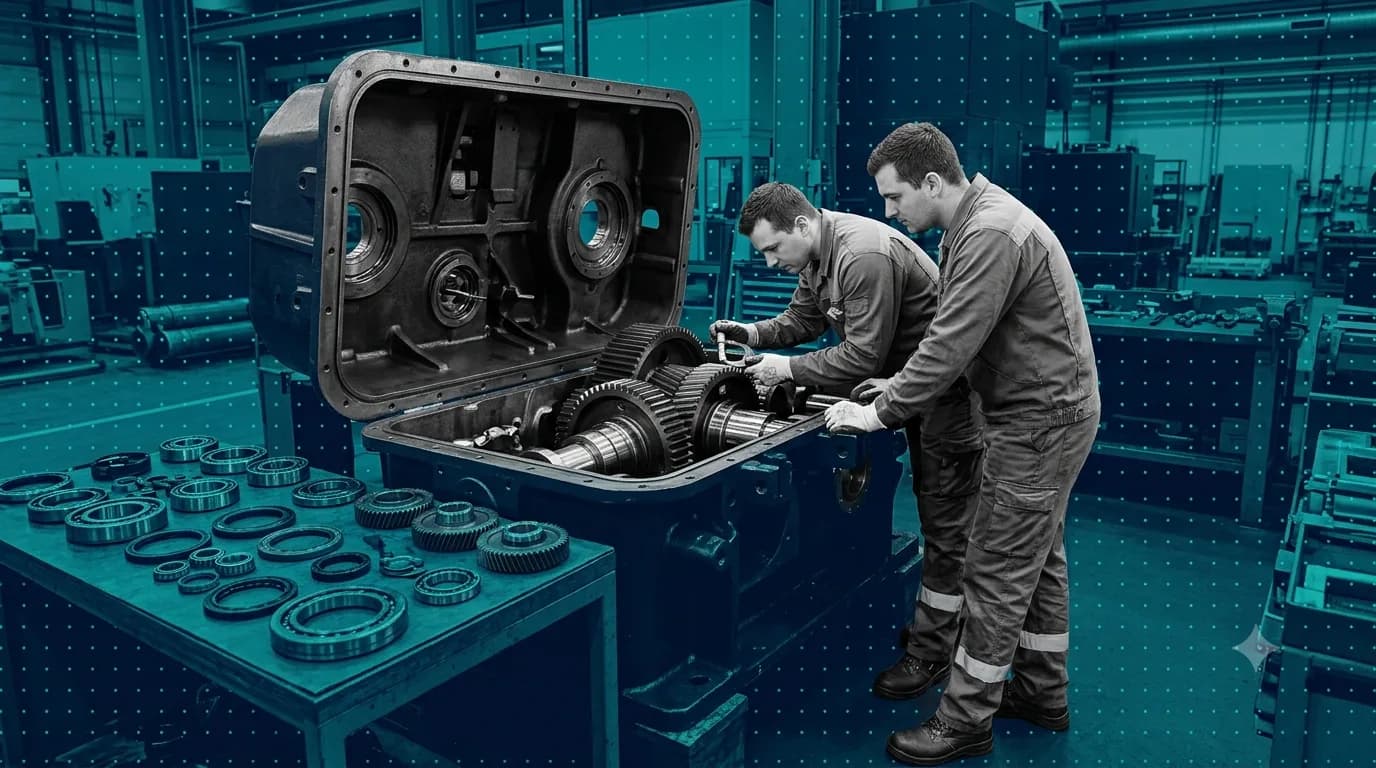




There are four main types of maintenance used in manufacturing: preventive (scheduled work to prevent failures), corrective (fixing faults found during inspections), predictive (condition-triggered work), and breakdown (reactive repair after failure). Most factories run a mix of all four; the goal is to push the balance toward preventive and away from breakdown.
What are the types of maintenance?
When maintenance managers talk about "types of maintenance," they are talking about what triggers a job — not what the job is. A bearing replacement can be preventive (scheduled calendar task), corrective (defect found during a PM round), predictive (vibration data crossed a threshold), or breakdown (the bearing seized and stopped the machine). The trigger determines the cost, the urgency, and the disruption to production.
The four types are not competing philosophies. Every plant runs all four simultaneously. The question is the proportion — and whether that proportion reflects a deliberate decision or just accumulated habit.
The way a factory's maintenance mix sits tells you a great deal about the program behind it:
- Mostly breakdown — reactive, expensive, unpredictable. Technicians spend their days firefighting rather than preventing. Spares are either overstocked (just in case) or perpetually out of stock (never anticipated).
- Mostly preventive and corrective — planned, predictable, cheaper per repair. The team knows in advance what work is coming, spares are kitted, and production can plan around the downtime window.
- Predictive layered on top — the most efficient state, where work is only done when the asset actually needs it. Requires investment in monitoring infrastructure and data interpretation skills.
None of this is theoretical. The shift from a reactive to a planned program is measurable — in downtime hours, repair cost, and the maintenance team's ability to sleep through the night without their phone going off.
Why do some lists say 5, 6, or even 9 types? You will find articles listing condition-based, predetermined, proactive, risk-based, and failure-finding maintenance as separate types. These are not additional triggers — they are subdivisions or combinations of the four above. Condition-based and predictive maintenance are the same trigger (the asset's measured condition) at different levels of sophistication. Predetermined maintenance is preventive maintenance by another name. Proactive maintenance is a philosophy that spans preventive, predictive, and corrective. Four triggers cover every job on the schedule; everything else is a refinement of how one of them is applied.
Not sure which maintenance mix your team is actually running?
Talk to usPreventive maintenance
Preventive maintenance (PM) is scheduled work done on a fixed calendar or usage-based interval, regardless of the machine's current condition. The logic is straightforward: components wear out on a roughly predictable timeline. Replace or service them before they fail, and the failure never happens. (For how to turn that into a working plan, see how to build a preventive maintenance schedule.)
Examples of preventive maintenance tasks:
- Replacing air filters every three months
- Lubricating conveyor chain bearings weekly
- Changing drive belts at 10,000 operating hours
- Inspecting safety guards and limit switches monthly
- Replacing hydraulic fluid on a 6-month schedule
The interval is set in advance — based on the manufacturer's recommendation, operating conditions, or historical failure data — and the job happens whether the component looks worn or not. That last point is where some plant managers push back: "We're replacing a perfectly good belt." The answer is that you do not know it is perfectly good without pulling and inspecting it. And the cost of a planned belt replacement during a scheduled window is a fraction of what it costs when the belt snaps at full production speed on a Monday morning.
The metric that matters: PM compliance rate
PM compliance rate is the percentage of scheduled preventive maintenance tasks completed within their due window. If 50 PMs were scheduled in a month and 42 were done on time, compliance is 84%. This is the leading indicator of your breakdown rate — not a management reporting number, but the number that tells you whether the program is actually running or just living on a spreadsheet.
Above 90% compliance on your critical assets is a functioning program. Below 80% means either the schedule is overloaded (too many PMs for the team's capacity) or the PMs are being deprioritized when production pressure arrives — which is when the PM program matters most and is most at risk of being skipped.
When to use preventive maintenance: Any asset where an unexpected failure causes significant production loss, safety risk, or secondary damage to connected components. On a critical machining line, a PM-driven bearing replacement costs an hour of planned downtime. The equivalent breakdown can cost a shift, a shaft, and an emergency freight charge for a replacement bearing from another city.
For a full checklist and interval-setting guide, see our preventive maintenance checklist.
Corrective maintenance
Corrective maintenance is work done to fix a fault or deterioration identified during a routine inspection or PM — but it is not an emergency. The machine is still running, or can safely wait, but the fault will become a breakdown if left unaddressed.
This type sits between preventive and breakdown, and it is the one most often misunderstood. It is not the same as a breakdown, because the fault was found before failure. It is not purely preventive, because it was not anticipated in advance on the schedule — it was discovered through inspection.
Examples of corrective maintenance:
- Replacing a cracked coolant hose noticed during a weekly PM walk-around
- Correcting belt misalignment found during a scheduled PM inspection
- Addressing a leaking hydraulic seal before it fails and contaminates the system
- Replacing a worn coupling identified during a vibration check
The critical distinction: corrective vs breakdown
The difference between corrective and breakdown maintenance is whether the work was planned or forced. In both cases, something is wrong with the machine. But:
- Corrective — the fault was found early, during a routine inspection. The machine is still running. The team can order spares, schedule a slot, kit the job, and assign an experienced technician during planned hours. The repair happens on the team's terms.
- Breakdown — the fault was not found early, or there was no inspection to find it. The machine has stopped. The plant is losing production now. Technicians are pulled from other jobs, spares may need to be sourced urgently, and the repair happens under pressure.
The same physical repair — replace the hydraulic seal — costs materially less when it is corrective than when it is breakdown. Not because the labor or parts are cheaper, but because planned work is efficient and reactive work is not. Emergency sourcing, overtime, production disruption, and secondary damage from the failure itself all inflate the true cost of breakdown maintenance.
This is why corrective maintenance deserves its own category. It is the intermediate state between a healthy program and a reactive one — and a high volume of corrective findings from your PM rounds is actually a good sign. It means the inspections are catching things before they catch you.
Predictive maintenance
Predictive maintenance (PdM) is maintenance triggered by condition monitoring data crossing a pre-set threshold. Unlike preventive maintenance — which happens on a fixed schedule — predictive maintenance happens when the data says the asset needs it.
The underlying idea: components do not fail instantaneously. A bearing that is about to fail has been vibrating differently for weeks. A motor that is about to overheat has been running hotter for days. If you can measure the right parameter, you can see the failure coming and act before it arrives — without doing the work earlier than necessary.
Examples of predictive maintenance techniques:
- Vibration analysis detecting early bearing wear before failure
- Oil analysis showing contamination or metal particles (indicating internal wear)
- Thermal imaging identifying hotspots in electrical panels or motor connections
- Ultrasonic testing detecting leaks in compressed air lines
- Current signature analysis monitoring motor health
When predictive maintenance makes sense:
Predictive maintenance works best on high-criticality assets where scheduled replacement is genuinely wasteful and where condition data is available or can be made available. If your preventive program replaces a bearing every 6 months on a fixed schedule, but that bearing typically has 10 months of usable life, you are replacing it at roughly 60% of its life — 40% of the cost is unnecessary. Predictive maintenance would let that bearing run until the vibration data indicates real wear, and replace it then.
An honest note on readiness:
Most small-to-mid manufacturing operations are not yet at predictive maintenance, and that is not a failing — it is a sequencing question. Predictive requires investment: sensors or measurement instruments, the time to take readings consistently, and someone to interpret the data. A plant that is running 60% reactive (breakdown-dominant) and does not yet have a structured PM program will not benefit from vibration analysis. The returns from building the preventive foundation first are larger.
Build the PM program, get PM compliance above 85%, then look at predictive for your highest-criticality assets. Predictive is the next level of a functioning maintenance program — not a shortcut past one.
Breakdown maintenance (run-to-failure)
Breakdown maintenance — also called run-to-failure or reactive maintenance — is the deliberate or de-facto policy of operating equipment until it fails, then repairing it. It gets a bad reputation, but it is not always the wrong choice.
When breakdown maintenance is a valid strategy:
Run-to-failure is a defensible policy for assets that meet all of the following conditions:
- Failure does not stop production or cause safety risk
- The failure mode does not cause secondary damage to connected components
- Spare parts are inexpensive and readily available
- Replacement or repair is fast
A workshop light fitting meets all four conditions. A non-critical conveyor on a parallel path that does not hold up the line meets them. Certain types of tooling meet them. Running these assets to failure and replacing them when they go is rational — maintaining them on a PM schedule would cost more than the failures.
When breakdown maintenance becomes a problem:
The problem is when run-to-failure is not a deliberate policy but accumulated neglect — assets that should be on a preventive program but are not, because the program was never set up, or because PM tasks keep getting skipped in favor of firefighting the last breakdown.
The other problem is secondary damage. A bearing that seizes does not just fail: it damages the shaft, the housing, and sometimes the adjacent components. The repair that would have cost $300 as a planned bearing replacement can become $4,000 when the shaft and housing are also damaged. This is the hidden cost of reactive maintenance that rarely appears in the maintenance budget — it shows up in parts costs and unplanned downtime, distributed across dozens of jobs.
Assets on a critical production path should never be deliberately run-to-failure. The risk profile is wrong: a single failure event stops production, and the secondary damage potential on complex machinery is high.
For a detailed guide on identifying and reducing breakdown maintenance, see our breakdown maintenance guide.
How the types work together — the maintenance mix
Every plant runs all four types simultaneously. The question is the proportion: how much of the team's work is planned (preventive, corrective, predictive) versus reactive (breakdown)?
The industry framing: above 70% planned work is a functioning maintenance program. Below 50% planned work means reactive firefighting is the de-facto strategy, regardless of what the PM schedule says.
| Maintenance type | Triggered by | Urgency | Relative cost per job |
|---|---|---|---|
| Preventive | Fixed calendar or usage interval | Planned | Lowest — work is anticipated, spares kitted, slot scheduled |
| Corrective | Fault found during inspection or PM | Planned, but unscheduled | Low to medium — fault is known, work can be planned |
| Predictive | Condition monitoring data threshold | Planned | Low to medium — work is planned, timed to actual need |
| Breakdown | Asset failure | Immediate (unplanned) | Highest — reactive sourcing, overtime, secondary damage |
The table above uses relative comparisons, not invented percentages. The actual cost difference between planned and reactive work on a specific asset depends on that asset's failure mode, spare-parts situation, and criticality. What the relative comparison consistently shows across manufacturing literature: planned work is cheaper per unit of output maintained than reactive work. The question for a maintenance manager is not whether this is true, but how to shift the mix.
What drives the mix toward reactive:
- PM tasks skipped when production pressure is high
- No system to capture corrective findings from PM inspections (they get forgotten before they become a work order)
- No work-order discipline — breakdowns reported verbally, not logged, so the pattern is invisible
- Spare-parts not available when needed, so PM windows get pushed
What drives the mix toward planned:
- A PM program with real compliance tracking (not just a schedule — execution data)
- Work orders raised for every corrective finding, assigned and dated
- Spare-parts kitted ahead of scheduled PMs
- A CMMS that surfaces overdue PMs before they become breakdowns
We've seen this pattern often enough on the shop floor to know it's not the exception: a plant running well over 80% reactive, where breakdowns get reported by someone walking over and telling the shift supervisor, not logged anywhere. The first change that actually moves the needle isn't a fancy PM schedule — it's forcing every breakdown and every corrective finding through a work order, even a simple one. Once the work is logged instead of spoken, the pattern that was invisible for years shows up in the first 90 days: the same three machines account for most of the downtime, and the "random" failures were never random at all.
Where TPM fits
The four maintenance types describe what triggers a job. Total Productive Maintenance (TPM) is the organizational system that makes the types work together rather than running in parallel without coordination.
TPM has three pillars directly relevant to the maintenance mix:
- Autonomous maintenance — operators are trained to handle first-line inspection, cleaning, and simple lubrication. They become the earliest detection layer for corrective findings that would otherwise only surface when the machine stops.
- Planned maintenance — the preventive schedule, executed by the maintenance team, with consistent PM compliance tracking and a discipline around capturing corrective findings.
- Focused improvement — structured root-cause elimination of repeat failures. When the same machine is generating the same breakdown every six weeks, TPM asks why the PM is not preventing it — and changes either the PM task, the interval, or the component specification.
Without TPM or an equivalent framework, the four maintenance types tend to run in parallel without feedback loops between them. Breakdowns happen, get repaired, and the root cause is not captured. Corrective findings from PMs are noted but not raised as work orders. The PM schedule drifts. The four types remain four separate activities rather than one integrated program.
The full TPM guide — including the eight pillars and how to sequence implementation — is here: Total Productive Maintenance: a practical guide.
In practice, the classification decision comes down to a rough cost comparison, not a formal criticality matrix. For each asset, weigh what a failure actually costs — lost production time, secondary damage to the shaft or housing, an emergency part sourced at a premium — against what a PM program on that asset would cost to run. If the failure math is clearly worse, it goes on PM. If a failure is cheap, self-contained, and fixed in minutes, run-to-failure isn't a shortcut — it's the correct call, and putting it on a PM schedule anyway is wasted effort better spent on the assets where the math actually matters.
Where MachDatum fits: the CMMS handles all four types from a single system. Preventive work orders are auto-dispatched on your configured schedule with the checklist pre-attached — no one needs to remember to raise them. Corrective work orders are raised directly from a PM finding, assigned and dated in the same session. Breakdown work orders capture the emergency response with root-cause fields so the same failure does not get handled as a surprise next time. The analytics view shows your breakdown-to-planned ratio per machine, so the shift from reactive to proactive becomes visible over time — not something you feel, something you can see in the numbers. We're onboarding our first group of manufacturing teams right now — see the full module.