
Corrective maintenance is any maintenance done after a fault is found, to put the asset back into working order. It covers emergency repairs after a breakdown and planned repairs of defects caught while the machine is still running. The European standard EN 13306 calls these immediate and deferred corrective maintenance.
A lot of definitions say corrective maintenance means fixing equipment after it breaks. Then, a few paragraphs later, they describe planned repairs of faults found on an inspection, which never broke anything. Both can't be the whole definition.
The mix-up isn't just about words. It decides how you count your work orders, and whether "more corrective work" reads as good news or bad news. This guide uses the standard definition, sorts out the different "types" lists you'll find online, works one gearbox fault through two timelines, and covers the decision in the middle: fix it now, or defer it.
What corrective maintenance means
In EN 13306, the European standard for maintenance terms, corrective maintenance starts at one point: a fault has been recognized. The work that follows aims to restore the asset so it can do its job again.
Two parts of that definition matter on the floor:
- The trigger is finding the fault, not the machine stopping. An operator can spot it, a PM route can catch it, a condition check can flag it, or the machine can announce it by breaking down. All of those start corrective work.
- The aim is restoration. You're putting the asset back to working order. Redesigning it so the fault can't happen again is improvement work, which is a separate job.
Typical corrective jobs in a plant:
- a gearbox oil seal that has started to weep
- a drive belt running misaligned or glazed
- a worn coupling element with visible cracking
- a motor that tripped on overload
- a gearbox that seized mid-shift
All five are corrective maintenance. The first three are usually found while the machine is still producing. The last two find you.
Preventive, condition-based and predictive maintenance all try to act before a fault exists or before it grows into a failure. Corrective maintenance is what you do once there's a fault to fix. Our types of maintenance guide shows how they fit together.
Types of corrective maintenance: immediate and deferred
EN 13306 splits corrective maintenance by timing:
- Immediate corrective maintenance is carried out without delay once the fault is found.
- Deferred corrective maintenance is not done straight away. It's held back and scheduled according to set maintenance rules, for example to the next planned stop.
Search for "types of corrective maintenance" and you'll find several answers that look like they disagree: planned and unplanned, immediate and deferred, breakdown and deferred, or a list of five classes. The first three are the same split in different language:
| EN 13306 term | Plant language | Shop-floor shorthand | When the repair happens |
|---|---|---|---|
| Immediate | Unplanned | Breakdown, emergency job | Now, whatever else is going on |
| Deferred | Planned | Found on inspection | In a slot you choose |
The shorthand is close, not exact. Immediate doesn't only mean breakdown. A hydraulic hose spraying near a walkway, or a guard found with its fixings missing, gets fixed now even if the machine could keep running. And not every fault found on inspection can wait. Some get fixed on the spot.
The five classes are a different axis. Some sources list five classes of corrective maintenance: fail repair, servicing, overhaul, rebuild and salvage. Those describe the size and kind of the work, not when it happens. A gearbox overhaul can be booked into a shutdown, or forced on you by a seizure at 2am. So any of the five can be immediate or deferred.
For planning, the split that matters is timing: immediate or deferred. How big the repair is (a fail repair, an overhaul, a rebuild) is a separate question.
Corrective maintenance example: one gearbox, two timelines
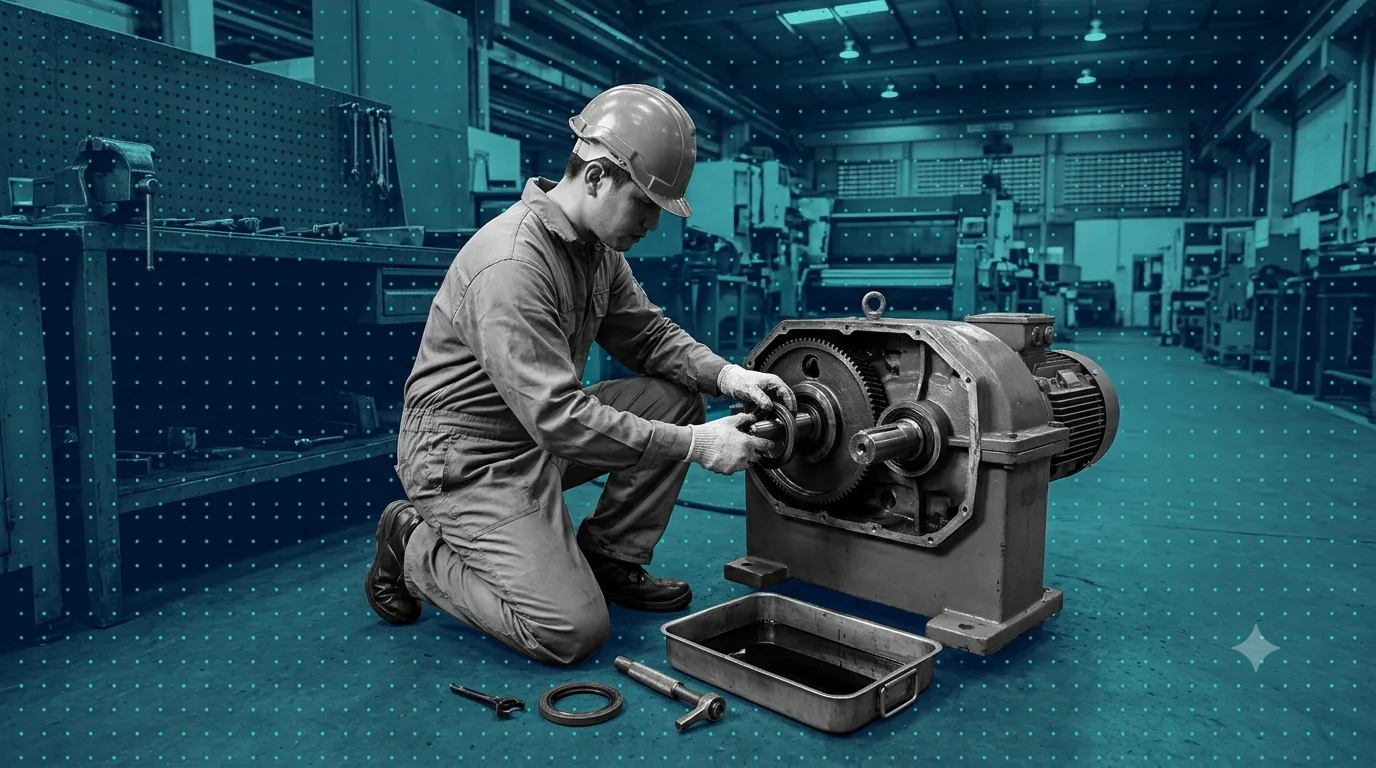
Illustrative example, not a customer case. A packing line has a conveyor driven through a helical gearbox. The fault is the same in both timelines: the oil seal on the gearbox output shaft has started to wear.
Timeline A: deferred corrective maintenance
- On the weekly PM route, the technician notices an oil weep at the output seal. The housing is also running warmer than the reading on last week's route sheet.
- The machine keeps producing. The technician raises a corrective work order on the spot, with photos of the weep, the asset, and the temperature reading.
- The planner checks the oil level, has it topped up, and adds an interim check: leak and oil level every shift until the repair.
- The seal kit is ordered. The job goes into Saturday's planned stop.
- On Saturday the drive is locked out. The old seal comes out, the shaft is checked for grooving, a new seal goes in, and the oil is changed.
- The conveyor runs under load, the seal is checked for leaks, and the job is closed with the failure mode and cause recorded.
Timeline B: immediate corrective maintenance
- The same weep is missed. Maybe the route was skipped that week, or someone saw it and didn't write it down.
- Three weeks later the gearbox has lost enough oil that the output bearing overheats and seizes mid-shift.
- The line stops. The operator calls maintenance. The shift technician diagnoses a seized gearbox, not just a leak.
- Stores has no seal kit and no spare bearing for that gearbox. Someone goes looking, while production decides what to do with the orders on the line.
- The repair happens under pressure to restart: seal, bearing, oil, and possibly the shaft if the bearing seat is damaged.
Side by side
| Timeline A: deferred | Timeline B: immediate | |
|---|---|---|
| How it was found | PM route inspection | The line stopped |
| Unplanned stoppage | None | From seizure to restart |
| Scope of repair | Seal and oil | Seal, bearing, oil, maybe shaft |
| Parts | Ordered ahead | Hunted for mid-shift |
| People pulled in | Technician, planner | Technician, supervisor, stores, production |
| Isolation | Planned lockout on a stopped line | Lockout with everyone waiting |
Same fault, same trade, two very different jobs. Both are corrective maintenance. What moved the job from Timeline B to Timeline A wasn't a better repair. It was someone looking at the gearbox, noticing the weep, and writing it down.
Want to see what a stop like Timeline B costs on your own line? Enter the hours, lost output and idle labor.
Open the downtime cost calculatorCorrective vs preventive maintenance, and where breakdown fits
| Preventive | Deferred corrective | Immediate corrective | |
|---|---|---|---|
| Trigger | A date, hours or cycles | A fault found while running | A fault that stopped it or made it unsafe |
| Timing | Before any fault | At a planned slot | Straight away |
| Who sets the clock | The PM plan | You, within limits | The fault |
| Work order source | PM schedule | Inspection, operator, condition check | Breakdown call |
Preventive and corrective maintenance aren't rivals. A good preventive maintenance schedule generates corrective work, because inspections find things. That's the point of them. Both preventive tasks and deferred corrective jobs count as planned maintenance: the work is known, prepared and scheduled before anyone starts.
Breakdown maintenance is the immediate kind of corrective maintenance when the trigger is a failure that has already stopped the machine. Every breakdown repair is corrective. Not every corrective repair is a breakdown. Our breakdown maintenance guide covers that difference and how to reduce breakdowns.
You'll also hear reactive maintenance. It's commonly used for the immediate kind: work that happens because something forced it, not because anyone planned it.
Fix it now or defer it? Five questions
Every fault found while a machine is running needs a decision. Usually the planner or supervisor makes it with the technician who found the fault. These five questions cover it.
- Is it a safety or environmental risk? Then fix it now, or stop and isolate the machine until you can. Production pressure doesn't change this answer.
- What happens if it fails before the next slot? Look for three things: secondary damage (a seal leak that takes out a bearing), a line stop on a bottleneck machine, and a quality escape (bad parts reaching a customer). If the consequence is small, deferring is cheap. If it's large, question 3 matters a lot.
- How much warning is left? Most faults get worse over time, from the point where they're first detectable to the point of failure. That's the P-F interval, explained in our reliability-centered maintenance guide. A slight weep may leave weeks. A bearing that is already noisy and hot may leave much less. If you can't tell, treat the window as short.
- Are the parts and skills available? Waiting for parts is a legitimate reason to defer, as long as it's recorded. If the parts are on the shelf and the right person is on shift, the case for waiting gets weaker.
- When is the next planned stop? If it's tomorrow, deferring is easy. If it falls after the warning window you estimated in question 3, either make a stop sooner or put interim controls in place until then.
If you defer, record the risk. Our deferred maintenance guide lists the five things to record every time: owner, reason, risk, new due date and interim control. In the gearbox example, the interim control was a leak and oil-level check every shift.
A deferral with no new date and no interim control isn't a decision. It's a job that has been forgotten, and it tends to come back as Timeline B.
The corrective maintenance process, step by step
The same steps apply to both kinds. For immediate jobs, steps 3 to 5 happen in minutes. For deferred jobs, they're where the time and the risk get managed.
- Detect. An operator, a PM route, a condition check, or the machine itself stopping.
- Raise the work order. Asset, symptom in plain words, photos, and where it was found. Raise it on the spot. By the end of the shift, details get lost.
- Triage. Immediate or deferred, and what priority. Use the five questions above.
- Plan. Parts, procedure, skills and isolation points. Work out the lockout/tagout steps before the day, not on the day.
- Schedule. Into the next planned stop, or now.
- Repair. Isolate, fix, and check the neighbors. A leaking seal is a reason to look at the shaft and the bearing behind it.
- Test under load. A quick bump test isn't enough. Run the asset at normal load and check for leaks, heat and noise before handing it back to production.
- Close the work order. Record the failure mode, the root cause, the downtime and the parts used. Our work order management guide covers the lifecycle and statuses.
- Feed back. Ask whether a PM task should have caught this, and if it did, whether it caught it early enough. Change the task or interval if it didn't.
Step 9 is the one most often skipped, and it's the one that moves future jobs from immediate to deferred.
What your corrective work orders tell you, and what they don't
Plenty of articles tell you to "reduce corrective maintenance." For the deferred kind, that's the wrong target. Corrective work raised from inspections is your PM program doing its job. Push teams to cut that number and you're asking them to find less.
A rising corrective count is ambiguous. Split it before you react:
- More deferred corrective work orders usually means inspections are finding faults early.
- More immediate corrective work orders means faults are getting past your inspections.
Watch the share by source, per asset. For each asset, count how many corrective work orders came from an inspection or operator report and how many came from a breakdown. There's no universal target for that share. What matters is the trend on your own assets, and which assets keep producing breakdowns.
A growing deferred backlog is risk piling up. Deferred jobs are faults you know about and haven't fixed. If the list keeps growing, it's not a sign of a healthy program. See deferred maintenance for how to work a backlog down.
MTTR measures repair speed, not whether the fault should have been caught. A fast breakdown repair is still a breakdown. MTTR tells you how quickly the team restores assets. MTBF tells you how often they fail. Decide up front whether a deferred repair like the seal change counts as a failure in your MTBF, and apply the rule the same way every time.
Not to be confused with
- Corrective action (CAPA) in quality systems. That's about removing the cause of a nonconformity in a product or process. Corrective maintenance restores an asset.
- Corrective maintenance in software engineering. That means fixing bugs in released software. Same name, different field.
Where a CMMS helps
The split between immediate and deferred corrective work is only useful if it's in your records. In most plants it isn't. A breakdown and a planned seal change both end up as "repaired gearbox" in a notebook or a chat thread.
In MachDatum CMMS, breakdowns and corrective repairs can be separate work order types, each with its own workflow. That puts the immediate versus deferred split in the work order data itself. Each transition can require the right data before a job moves on: root cause when repair starts, downtime hours when it closes, and the failure mode recorded the same way every time. Every repair lands in the asset's history.
On the floor, a technician can scan the asset's QR tag in the mobile app, raise the work order there and then, and attach photos of what they found. The comment thread keeps the conversation on the job. For deferred work, due-date reminders and escalation rules keep a job from quietly sliding past its date. And when step 9 says a PM task needs to change, the PM plan and its checklist live in the same system. MTBF, MTTR and downtime by asset come straight from the work order data.
If your machines are monitored with ThingConnect, MachDatum's sister product, an unplanned stop that the operator reason-codes opens a corrective work order automatically, with the asset, downtime and failure mode already filled in.
We're onboarding our first group of manufacturing teams. If your corrective work lives in notebooks and chat threads, see how MachDatum CMMS handles work orders and asset history.