

Breakdown maintenance is unplanned repair carried out after equipment fails unexpectedly, to restore it to working condition. It is the opposite of preventive maintenance. The machine stops, production stops, and the maintenance team responds — rather than preventing the failure in the first place. Also called reactive maintenance, corrective maintenance, or run-to-failure maintenance.
Every plant does some breakdown maintenance. The question is how much, and on which assets. A compressor that costs $500 to replace and stops a non-critical line for 20 minutes is a reasonable run-to-failure candidate. A hydraulic press that stops an assembly line producing $60 a minute is not.
The rest of this guide covers the types, the real costs, the root causes, and the practical steps to reduce it where it matters.
What is breakdown maintenance?
Breakdown maintenance means you wait for the failure, then fix it. No schedule, no inspection interval, no early-warning trigger — the fault finds you.
The formal definition: unplanned corrective action taken after a functional failure, to restore an asset to its required operating condition.
Three things make it distinct from other types of maintenance:
- Unplanned. Nobody scheduled this repair. The job arrives without warning, often mid-shift or mid-run.
- Post-failure. The intervention happens after the asset has already stopped working, not before.
- Reactive. The trigger is the failure itself, not a calendar date, a runtime reading, or a sensor threshold.
Breakdown maintenance is also known as reactive maintenance, corrective maintenance, or run-to-failure maintenance. The terms are used interchangeably on most factory floors, though corrective maintenance can sometimes refer to planned corrections of degraded-but-still-running equipment, and run-to-failure specifically describes the deliberate strategy of letting low-priority assets run until they fail. The core meaning is the same: the machine failed, now fix it.
One example that stays with me: we were on-site at a heat treatment facility replacing a propane yard level sensor — a critical instrument, because without a live propane level reading, the entire heat treatment section shuts down. Clean installation, correct wiring, everything checked with the customer. The replacement sensor powered up and immediately died. No signal, never recovered. Not a wiring fault, not the wrong part — the sensor simply failed on startup, before it had ever taken a single measurement.
That's breakdown maintenance in its rawest form. The failure finds you regardless of preparation. Your only job at that point is to respond.
Still logging breakdowns in a notebook instead of a system?
See how MachDatum logs itTypes of breakdown maintenance
Not all breakdowns look the same. Two main types:
Sudden (emergency) breakdown
The machine stops completely, without warning, and production halts immediately. This is the 2am phone call, the line going silent in the middle of a shift, the sound that every maintenance supervisor recognizes and dreads.
Common examples: bearing seizure, blown fuse, seal failure, motor burnout, hydraulic line rupture. The asset was running fine — until it wasn't.
Emergency breakdowns are visible and expensive. They create immediate pressure to get the line back up, which often means overtime, expedited parts, and skipped root-cause analysis. That last shortcut is why the same failure often happens again, 14 months later.
Intermittent breakdown
The machine fails, gets restarted, runs for a while, fails again. Each individual event seems minor — a short stop, a reset, a quick workaround. The pattern is more insidious than a single catastrophic failure precisely because no one event demands a proper investigation.
Intermittent breakdowns are the developing faults: worn brushes on a motor, a partially clogged filter, a loose electrical connection that makes contact most of the time. Left unresolved, intermittent breakdowns usually become emergency breakdowns — typically at the worst possible moment (night shift, peak season, the day before a customer audit).
Comparison
| Sudden breakdown | Intermittent breakdown | |
|---|---|---|
| Onset | Immediate, without warning | Gradual, recurrent pattern |
| Production impact | Line stops immediately | Line degrades, stops periodically |
| Examples | Bearing seizure, motor burnout, blown fuse | Loose connection, worn brush, partial clog |
| Detection difficulty | None required — obvious | Easy to dismiss; requires pattern recognition |
| Risk | High response cost | Becomes sudden breakdown if ignored |
| Correct response | Repair + root-cause capture | Investigate and fix the developing fault |
Breakdown maintenance vs corrective maintenance
These two terms get used interchangeably on most shop floors, and for day-to-day purposes that's harmless. When you're categorizing work orders — or reading a standard — the distinction matters.
Corrective maintenance is the repair of a known defect. Breakdown maintenance is the repair of a defect that has already stopped the machine.
Every breakdown repair is corrective. Not every corrective repair is a breakdown repair.
The case that separates them is the fault you find before it stops anything. A technician on a PM route notices a bearing running hot. The machine is still producing. You order the bearing, schedule the swap for Saturday's planned shutdown, and replace it on your terms. That is corrective maintenance — you corrected a defect — but it was never a breakdown, because production never stopped unplanned.
| Breakdown maintenance | Planned corrective maintenance | |
|---|---|---|
| Trigger | Functional failure — the asset has stopped | A defect found while the asset still runs |
| Timing | Immediately, whenever it happens | Scheduled into a shutdown or a quiet slot |
| Parts | Whatever you can get, at whatever price | Ordered ahead, correct specification |
| Production impact | Unplanned downtime | Planned, usually absorbed by an existing stop |
| Who sets the clock | The failure | You |
The practical reason to keep them separate in your records: if every corrective job is logged as a breakdown, your unplanned-downtime figure is inflated, and you lose the one comparison the run-to-failure decision actually rests on — what you spend on planned downtime against what unplanned downtime costs you. That trade-off is the whole judgment, and you cannot make it from a log where both look the same.
For where both sit among the other strategies, see types of maintenance.
Examples of breakdown maintenance
Not all equipment deserves a preventive maintenance program. Here are common examples where breakdown maintenance is the deliberate, cost-effective choice:
- Light fixtures and fluorescent tubes. Low cost, no production risk, five-minute replacement. A PM schedule for light bulbs costs more than the bulbs.
- Non-critical conveyor guides and rollers. A $50 roller on a secondary sorting conveyor that has redundancy on the line is a run-to-failure candidate. The failure stops nothing critical.
- Office and administrative equipment. Printers, monitors, fans in non-plant areas. Failure has no production impact; replacement is faster than a scheduled maintenance visit.
- Fuses and circuit breakers. Designed to fail as a protection mechanism. Scheduling preventive replacement defeats the purpose — the failure event is the signal.
- Ventilation units in storage areas. Production continues without them. Spare units typically exist; downtime is zero.
- Low-value consumable tooling. Manual gauges, hand tools, jigs on non-critical fixtures. Cheaper and faster to replace on failure than to inspect and maintain.
The common thread: failure stops nothing critical, the repair or replacement is fast and inexpensive, and a PM schedule would cost more to run than the failures cost.
The real cost of a breakdown
The repair invoice is the smallest part of the cost. A three-hour breakdown on a busy line involves costs that never appear in the maintenance budget.
Direct costs
- Replacement parts (at whatever price your supplier quotes when you call at midnight)
- Labor — the maintenance team, often on overtime
- Any specialist called in from outside
Indirect costs
- Lost production: every minute the line is down, throughput that cannot be recovered
- Scrap from the restart: parts in-process when the failure happened, and the first batch off a cold machine, are often rejected
- Missed deliveries: penalty clauses, airfreight to catch up, goodwill cost with the customer
- Expediting raw material: the buffer stock you hadn't planned to burn through
- The hidden cost: a maintenance team in permanent firefighting mode has no time to do the preventive work that would stop the next breakdown
Illustrative worked example (numbers are illustrative — substitute your own line's data)
A press line runs at $60 of output per minute on a two-shift, six-day week. A sudden bearing failure stops the line for three hours.
| Cost element | Calculation | Amount |
|---|---|---|
| Lost throughput | 180 min × $60/min | $10,800 |
| Overtime (2 technicians, 4 hrs each) | 8 hrs × $65/hr blended | $520 |
| Replacement bearing (emergency rate) | — | $200 |
| Scrap from restart | 40 pieces × $5 avg. | $200 |
| Total estimated cost | ≈ $11,720 |
The repair bill (bearing + labor) is under $750. The production loss is over $10,000. This is why the maintenance budget is the wrong lens for evaluating breakdown maintenance — the real cost sits in the production P&L, not in maintenance spend.
Why breakdowns happen
Four honest root causes. They are not new — every maintenance manager recognizes them. The problem is that recognizing them and fixing them at the system level are different things.
1. No preventive maintenance, or PM slippage
The most common cause, and the most avoidable. The PM was on the schedule. The scheduler was on leave. The technician was pulled onto a breakdown. The machine ran past its service interval for six weeks. Then it failed.
PM slippage — PMs that exist on paper but don't get executed — is the single biggest source of avoidable breakdowns. A PM program that misses 30% of its scheduled tasks is not a PM program.
2. Operator-induced failure
Incorrect operation, missing lubrication, ignored early warning signs. An operator who notices a new noise and says nothing because "it's always made that sound". A machine run above its rated load because production pressure is higher than written procedure.
This is not a blame issue — it's a system issue. If the operator has no formal channel to report an abnormality (a checklist, a work-order route, a supervisor who follows up), the abnormality goes unreported.
3. Age and fatigue
Components running past their rated life because nobody tracked it. The seal that was last replaced three years ago and should have been replaced at two years. The drive belt that's been inspected and "looks fine" because the technician is measuring it with his eyes rather than a gauge.
Most plants don't have asset-level component histories. They have a maintenance register that says the hydraulic press was serviced, without recording which components were replaced and when.
4. Wrong spares
The correct part wasn't in stock. The maintenance team substituted a similar part — different tolerance, different material, close enough. The machine ran. The substituted part failed in 18 months instead of five years, and when it failed nobody connected it to the substitution 18 months earlier.
A poor storeroom is a breakdown-maintenance multiplier: the wrong spare extends the repair time, creates a sub-standard repair, and introduces a future failure mode.
Breakdown maintenance procedure: what to do when a machine stops
Most plants have no written breakdown procedure. The response depends on who is on shift, which is why the same failure produces a 40-minute repair one week and a four-hour repair the next.
A procedure does not slow the response down. It removes the decisions nobody should be making under pressure.
1. Make it safe before anything else. Stop the machine properly, isolate the energy sources, apply lockout/tagout, and confirm zero energy. Every shortcut taken here is taken while somebody is in a hurry — which is exactly when the shortcut costs someone a hand.
2. Raise the work order now, not afterwards. The single most common documentation failure is reconstructing the job at the end of the shift from memory. Downtime gets rounded, the start time is a guess, and the parts list is whatever the technician remembers. Open the work order when the machine stops, so the clock starts on its own.
3. Triage before you dispatch. Two questions: does this stop production, and is there a workaround? A stopped critical asset with no redundancy takes the whole team. A degraded auxiliary unit with a bypass waits until the critical job is done. Without this step the loudest request wins instead of the most important one.
The supervisors who get this consistently right are the ones who understand production priorities, not just maintenance ones. Whether a stopped machine actually matters this shift depends on the production schedule, the order book, and what is buffered downstream — none of which lives in the maintenance system. A supervisor working only from the maintenance queue ranks jobs by what is loudest or most broken. A supervisor who knows what production owes a customer on Friday ranks them by what genuinely threatens it.
4. Diagnose before you replace. The pressure to get the line running rewards swapping the obvious component. Sometimes that is right. But the part that broke is not always the part that failed — ask what made this part fail, before the machine is running again and the question stops feeling urgent.
This is where breakdown work is genuinely harder than preventive work, and where technicians separate. A PM is prepared: you know the asset, the task and the parts before you start. A breakdown gives you none of that. The skill is taking what you can get from three sources — the operator who was standing there, the machine itself, and the documentation — forming a hypothesis quickly, and testing it before committing to a repair.
Working alongside the plant engineering and maintenance department at a large automotive components plant, the thing that most reliably separated a strong technician from an average one was unglamorous: how fast they could find the right document, and whether the one they found was the current revision. Not diagnostic instinct — document retrieval. That is a solvable problem, and in most plants it is solved badly.
5. Repair with the correct part. A substituted spare that is "close enough" is a future breakdown you have scheduled without meaning to. If you must substitute to restore production, record the substitution on the work order and raise a follow-up job to fit the correct part.
6. Verify before handover. Run the machine under real load, not just power-on. Confirm the output is within spec — a heater running slightly low or a drive running slightly fast will produce parts, just not good ones. Hand back to production explicitly, so there is no ambiguity about whether the asset is released.
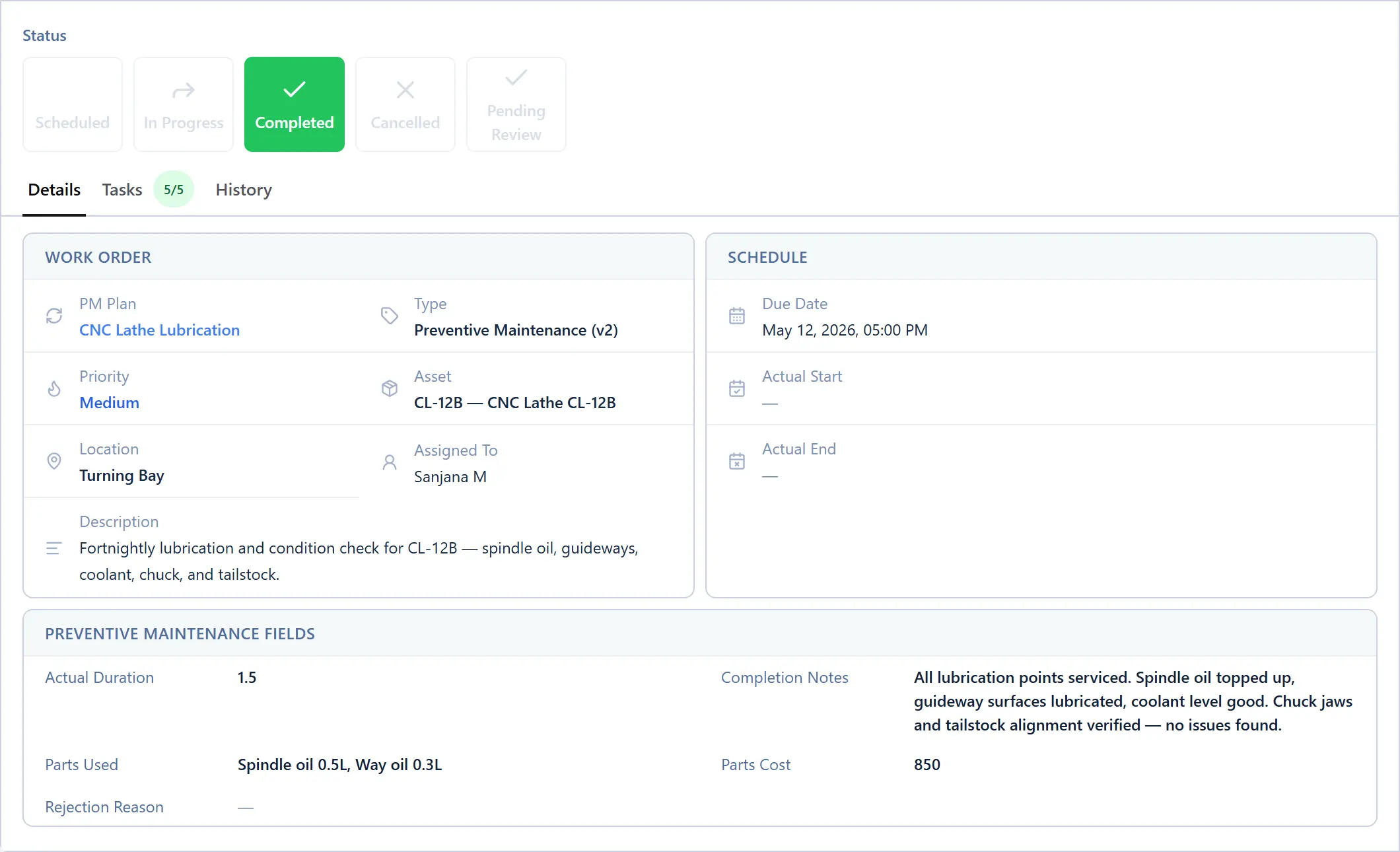
7. Close with root cause and downtime. This is the step that gets skipped, and it is the only one that changes anything next time. Record what failed, why it failed, what was done, which parts were used, and the actual downtime duration.
The information usually exists somewhere already — in a logbook, a message thread, a spreadsheet on somebody's desktop, a technician's memory. What is missing is a durable record: one place where the history outlives the person who created it. Scattered data is the normal condition of a maintenance function, not an unusual failure of one plant. The point of closing a work order properly is not the paperwork — it is that the next person who meets this failure inherits what you learned instead of starting over.
Breakdown response checklist
| Step | Check | Why it matters |
|---|---|---|
| Safety | Isolated, locked out, zero energy confirmed | The only irreversible risk on this list |
| Work order | Raised at the moment of the stop | Downtime is measured, not estimated |
| Triage | Criticality and workaround assessed | The right job gets the team first |
| Diagnosis | Failure mode identified, not just the broken part | Stops the repeat failure |
| Parts | Correct specification fitted, substitutions logged | Prevents a scheduled future failure |
| Verification | Run under load, output within spec | Catches quality damage before the customer does |
| Handover | Asset formally released to production | No ambiguity about machine status |
| Closure | Root cause, parts, and downtime recorded | Builds the history the PM program is planned from |
Advantages and disadvantages of breakdown maintenance
| Advantages | Disadvantages |
|---|---|
| Zero PM overhead on non-critical assets | No warning — production stops immediately |
| No inspection or scheduling labor cost | Emergency parts and overtime cost more |
| Simpler to administer for low-priority equipment | Root causes go uncaptured; same failure repeats |
| Appropriate where failures are random and don't respond to PM | Maintenance team locked in firefighting mode |
| Lower upfront maintenance spend on run-to-failure assets | Hidden production loss costs far exceed visible repair costs |
The disadvantages dominate on critical assets. The advantages are real on non-critical ones. The decision is about which category each asset falls into — and most plants never formally make that call.
When breakdown maintenance is the right choice
This section matters because the honest answer is: sometimes, running to failure is the right decision.
Not every asset justifies a preventive maintenance program. A $50 conveyor belt guide roller that takes 15 minutes to replace, sits on a non-critical auxiliary line, and has never caused a production stop — building a monthly PM task around that asset costs more than the failure.
The decision framework has three variables:
- Asset criticality: does a failure stop the line, or is there redundancy? Can production continue?
- Cost of failure: what does the actual breakdown cost — parts, labor, lost production, penalties?
- Cost of the PM program: what does executing the PM task cost, every cycle, for the life of the asset?
For a plant with 200 assets, a realistic breakdown is: 30–40 assets are run-to-failure candidates. The other 160 need a PM program — because the cost of failure, the criticality, or both, make preventive work clearly cheaper.
The error most plants make is not the deliberate run-to-failure decision. It's that the failure-vs-PM analysis is never done at all, so the most critical assets end up in breakdown maintenance by default rather than by design.
The run-to-failure call comes down to one question: does this asset fail clean, or does it fail slowly?
If it works until it stops — a fuse, a light fixture, a simple solenoid valve — and the replacement is fast and cheap, that's a legitimate run-to-failure candidate. The failure is sudden, the impact is visible and contained, and you're back running quickly.
The asset that should never run to failure is the one that quietly degrades your output before it breaks. A worn seal that starts passing contaminants. A heater element running slightly low, producing parts at the wrong temperature. These don't fail clean — they compromise quality gradually, then break. By the time the breakdown event happens, the quality problem is already in the system.
How to reduce breakdown maintenance
Reducing breakdown maintenance is not complicated. It requires consistent execution of a small number of tasks — which is harder than it sounds in a plant where the maintenance team is being pulled between the breakdown happening right now and the PM that was due last week.
Start with your top 20 assets by downtime hours
Pull your work-order history for the last 12 months. Rank assets by total downtime hours contributed. The top 20 are where your PM program should start — because those are the assets where a preventive task has the highest payoff.
If you don't have 12 months of work-order history, start collecting it now. Every breakdown goes into a work order, with the asset identified and the downtime duration recorded. In six months you have your ranking.
Track MTBF per asset
Mean Time Between Failures (MTBF) tells you how long a machine runs between breakdowns. A single MTBF number is an average. The trend over time is where the signal is.
A machine whose MTBF has dropped from 90 days to 45 days over six months is telling you something is getting worse — a developing fault, a component past its service life, a lubrication task being missed. The trend catches it before the catastrophic stop; a single snapshot doesn't.
MachDatum computes MTBF per asset automatically from closed work orders. As each breakdown work order is closed with a recorded downtime duration, the MTBF trend updates — so the machines that are starting to fail more frequently become visible before they stop the line. See the full list of CMMS KPIs MachDatum tracks.
Require root-cause capture on every breakdown work order
If a work order can be closed without recording a root cause, it will be. The breakdown will happen again, and again, until someone is forced to ask why.
Make root-cause capture mandatory — not optional, not free-text, required before the work-order status changes to closed. The failure modes repeat because the root causes aren't captured at the system level. Fourteen months later, the same seal fails, and the team treats it as a new event rather than a recurrence.
The data builds over time. The second time a failure mode appears on the same asset, it's a pattern. The third time, it's a PM task that needs to be added or a spare that needs to be stocked.
Build a preventive maintenance program for your critical assets
A PM program only reduces breakdowns if the PM tasks actually get executed. The most common reason they don't: the scheduler is away, the board gets cleared for a breakdown, the PM slips one week, then two, then it's six weeks overdue and the machine fails.
Auto-dispatched PM work orders — work orders that are created and assigned automatically on schedule, without requiring someone to remember to create them — eliminate PM slippage as a root cause. When the PM fires automatically and sits in the technician's queue with a due date, it requires an active decision to skip it. That's a fundamentally different situation from a PM that requires someone to remember it exists.
A preventive maintenance checklist that runs on time is worth more than an elaborate PM library that runs at 70%.
Where MachDatum fits: every breakdown becomes a work order with a named assignee, a root-cause field required before closure, and a recorded downtime duration. MTBF per asset updates automatically with every closed work order, so the machines that are starting to fail more frequently become visible before they stop the line. PM auto-dispatch means PMs don't get missed when the scheduler is on leave — the work order fires and sits in the technician's queue. We're onboarding our first group of manufacturing teams right now — see how it works.