
Forklift maintenance under OSHA 29 CFR 1910.178(q) is two connected obligations, not one: a safety examination before the truck is used, done "at least daily" (1910.178(q)(7)), and a maintenance record of repairs and parts (1910.178(q)(1), (q)(5)) that shows the truck stayed in safe operating condition. In the plants we've worked with, it's usually the maintenance record side that runs reliably — repairs get logged, parts get tracked. The daily inspection actually tied back into that record is the part we've rarely seen done well.
The daily inspection requirement
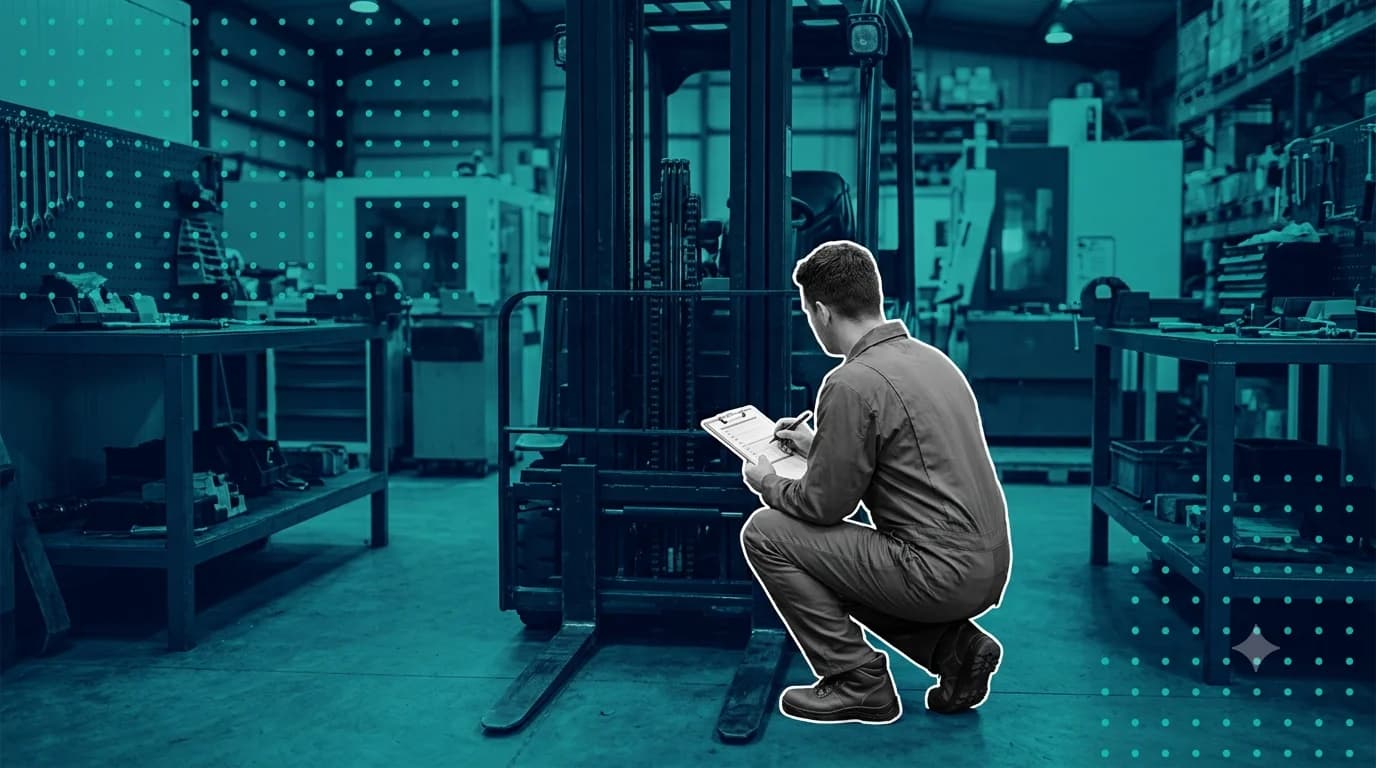
1910.178(q)(7) is specific about timing, not just content: "Industrial trucks shall be examined before being placed in service, and shall not be placed in service if the examination shows any condition adversely affecting the safety of the vehicle. Such examination shall be made at least daily." Daily is a floor, not a suggestion — a truck used across multiple shifts needs an examination before each shift it's placed into service, not once every 24 hours on a clock.
The companion rule is 1910.178(q)(1): "Any power-operated industrial truck not in safe operating condition shall be removed from service." This is where a daily checklist stops being a paperwork exercise. If the pre-shift check finds a condition that affects safety — a hydraulic leak, worn forks, a brake that doesn't hold — the truck doesn't get flagged for "next service." It comes out of service now, and the removal itself is the compliance action, not a note for later.
What the daily check needs to cover, at minimum: brakes, steering, horn and warning devices, tires, forks and mast for visible damage, hydraulic leaks, and — for LP or electric trucks — the fuel or battery system. The exact items vary by truck type; the manufacturer's operator manual is the authoritative list for a specific model, not a generic template.
What the maintenance record needs to show
The daily inspection catches what's wrong today. The maintenance record is the separate obligation that shows what was done about it — and two more parts of 1910.178(q) govern that side specifically:
- 1910.178(q)(5): "All parts of any such industrial truck requiring replacement shall be replaced only by parts equivalent as to safety with those used in the original design." A repair record needs to show what part was replaced and that it met this standard — not just that "repair completed."
- 1910.178(q)(4): repairs to the electrical system require the battery disconnected first — a sequencing requirement a maintenance record can demonstrate was followed, if it captures more than a one-line "fixed."
A record that shows dates and a technician's initials satisfies almost nobody in an actual audit. What holds up is a record that connects a specific finding (what the daily check caught, or what failed in service) to the specific work order, parts used, and who did the work — the same chain an OSHA inspector or an insurance auditor is going to ask to see reconstructed.
Where this breaks down in practice
The daily check gets done but never recorded. A technician walks the truck, finds nothing wrong, and the check exists only as the fact that the truck got used that day. No record. If a truck fails a week later, there's no way to show the daily inspection was actually happening — the requirement was met in practice and unprovable on paper, which in an audit is functionally the same as not having done it. This is the pattern we've seen most often — most plants are doing the inspection, they're just not capturing it. It usually doesn't surface as a problem until an internal audit goes looking for the record and finds nothing to point to.
The daily check gets skipped under production pressure. The forklift is needed on the floor at shift start, the checklist sits at the operator station, and "I'll do it after this load" becomes not doing it at all once the shift is moving. This is the more common failure mode than a check done badly — it's a check not done, quietly, on the days the plant is busiest and the truck is under the most load. It's also the most direct failure mode we've seen — not a bad check, a skipped one, and production pressure is almost always the reason given for it.
The record exists but nobody connects it back to the daily check. Repairs get logged in a maintenance log. Daily inspections get logged on a separate paper form, if at all. When the two live in different places, nobody can answer "did the finding from Tuesday's check turn into the work order from Thursday" — which is exactly the connection an audit is checking for. In practice, this usually isn't two systems — it's one system and one piece of paper. The daily inspection sits on a paper form at the operator station; only the repairs that come out of it ever make it into whatever system tracks maintenance. The two never actually meet.
For forklift battery-charging areas specifically — a related but separate compliance obligation under OSHA 1910.178(g) covering ventilation and hydrogen gas risk — see our industrial fire safety checklist guide, which covers that requirement in the depth it needs rather than repeating it here.
How MachDatum supports this
A daily inspection finding and the maintenance record it produces are the same kind of gap MachDatum's work order flow is built to close: an inspection finding becomes a work order directly, with parts used, downtime, and technician captured as mandatory fields — not an optional note that gets skipped when the shift is busy. See our guide to work order management for how that transition from finding to closed work order actually works, and equipment maintenance log template for what a usable record needs to capture regardless of which system holds it.
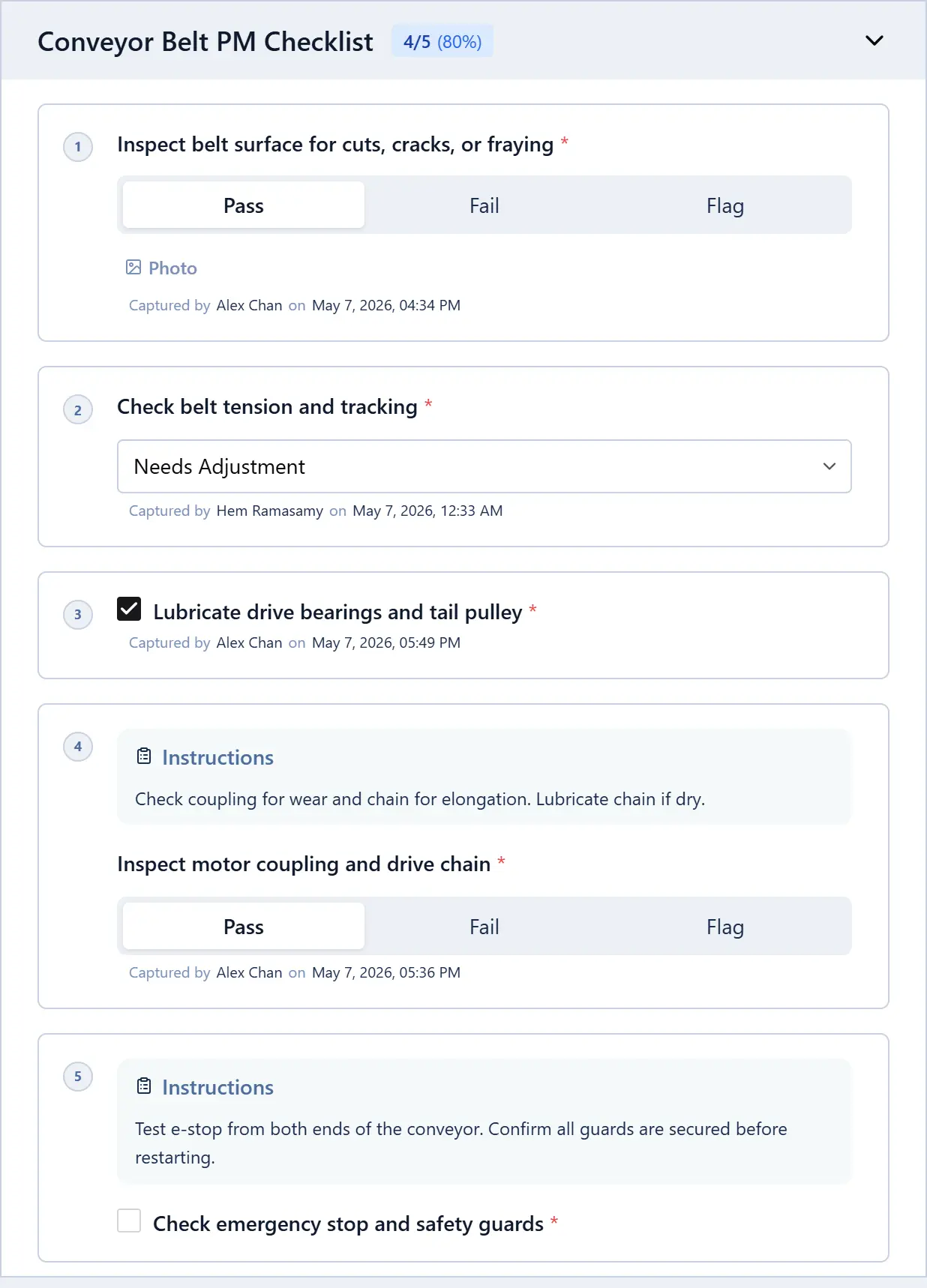
Where MachDatum fits: MachDatum's configurable workflow model lets you set up a dedicated inspection work order type — so a daily forklift check isn't logged the same way as a repair, and a finding on that check routes straight into a real work order instead of staying on a paper form. We're onboarding our first group of manufacturing teams right now — see how it works at machdatum.com.