



An industrial fire safety checklist for a manufacturing plant needs to cover more than the generic building items most templates list — exits, extinguishers, and alarms matter everywhere, but a plant floor has its own risks: hot work, combustible dust, solvent storage, and electrical panels under continuous load. The checklist below covers both.
The generic items (every template has these)
- Fire extinguishers present, inspected, and within service date at every required location
- Exit routes and emergency exits clear, unlocked, and clearly marked
- Fire alarm and detection system tested and functional
- Assembly point designated and known to staff
- Emergency contact numbers posted and current
These are table stakes. Every insurer and fire-code checklist covers them, and they should be checked regularly — but they're not where a manufacturing plant's real fire risk usually sits.
Manufacturing-specific risks generic checklists miss
Combustible dust. Metalworking, woodworking, and powder-handling operations generate fine particulate that can flash or explode under the right concentration and ignition source. NFPA 652 requires any facility that manufactures, processes, or handles combustible dust to complete a documented dust hazard analysis (DHA), reviewed and updated at least every five years; NFPA 654 sets the manufacturing-specific requirements for controlling the hazard once it's identified. The checklist item that matters here isn't "dust collection system present" — it's dust collection cleaned on schedule against a documented DHA, because a collection system that's never emptied just concentrates the hazard in one place. This is one of the two categories most industrial fire safety checklists skip entirely.
Forklift battery-charging stations. Charging generates hydrogen gas, which becomes explosive above roughly 4% concentration in air — a specific, well-documented risk that a general building checklist has no reason to mention. OSHA 29 CFR 1910.178(g) and NFPA 505 require charging areas to have adequate ventilation to disperse gassing fumes, facilities for flushing spilled electrolyte, fire protection, and protection of the charging apparatus from truck damage. This is the second category most checklists skip entirely.
Hot work and welding zones. Any cutting, welding, brazing, or grinding operation is an ignition source. NFPA 51B requires a 35-foot combustible clearance radius around the hot work point — in all directions, including through wall and floor openings — and a certified fire watch whenever combustibles sit within that radius. The fire watch's job doesn't end when the torch goes off: NFPA 51B calls for continuous monitoring for a minimum period after work stops (check your local adopted edition — durations have shifted between editions), because smoldering material can ignite well after the work itself is done.
Flammable solvents and degreasers. Parts-washing stations, paint booths, and adhesive-application areas often store solvents in quantities and proximity that a generic office-building checklist never anticipates. Check storage cabinet ratings, grounding/bonding during transfer, and proximity to ignition sources — not just "solvents stored properly," which tells an inspector nothing.
Electrical panels and continuous-load equipment. Industrial equipment draws sustained high current in a way office buildings don't. NEC and OSHA 1910.303 require a minimum working clearance in front of electrical panels — commonly 36 inches for equipment up to 150 volts, more at higher voltages — kept clear of storage, not just "accessible in an emergency." Add thermal signs of overload (discoloration, smell) to the check, not just assumed absent because nothing has tripped yet.
The checklist
| Item | Standard | Frequency | Sign-off |
|---|---|---|---|
| Dust collection system emptied/cleaned against a documented DHA | NFPA 652 / 654 | Per schedule (varies by process volume) | ☐ |
| Forklift charging area ventilation confirmed, spill-flush station present | OSHA 1910.178(g) / NFPA 505 | Monthly | ☐ |
| Hot work permits issued, 35-ft radius cleared, fire watch logged | NFPA 51B | Per job | ☐ |
| Solvent storage cabinets rated and closed | — | Weekly | ☐ |
| Electrical panels: working clearance kept clear, unobstructed | NEC / OSHA 1910.303 | Monthly | ☐ |
| Extinguishers present, charged, in-date | NFPA 10 | Monthly | ☐ |
| Exit routes clear and marked | — | Monthly | ☐ |
| Fire alarm/detection tested | Per local code | Quarterly | ☐ |
Making sure it actually gets done
A checklist that exists as a PDF in a binder has the same failure mode as a preventive maintenance schedule kept in Excel: it doesn't matter how thorough it is if nobody enforces whether it happened. The same PM-slippage pattern that causes breakdown maintenance to spike also causes fire safety checks to lapse — the inspection was scheduled, the person doing it got pulled onto something else, and three months pass before anyone notices.
The fix isn't a better checklist. It's making the checklist a recurring, assigned task with a due date that someone has to actively skip rather than passively forget — the same principle behind PM auto-dispatch for any other scheduled maintenance work.
How MachDatum handles this
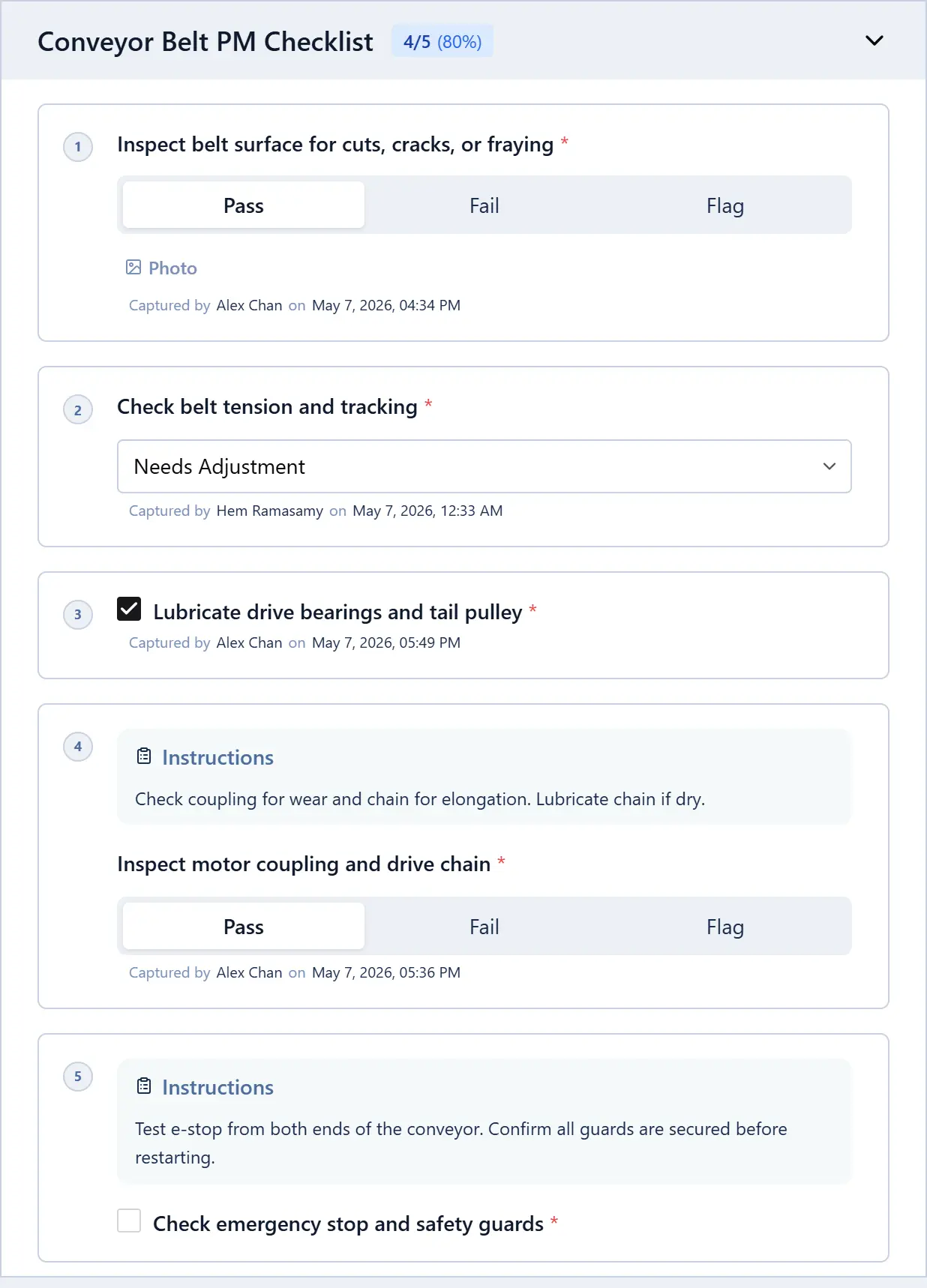
A fire safety checklist works the same way as any other inspection in MachDatum: a recurring work order type, auto-dispatched on schedule, with configurable fields per item and mandatory photo evidence before sign-off. The inspection history lives with the asset or the facility, not in a binder that only gets pulled out when an auditor asks for it.
Where MachDatum fits: a fire safety checklist becomes a recurring inspection work order — auto-dispatched, with mandatory photo evidence and sign-off before it can close. No separate binder, no relying on someone remembering the schedule. We're onboarding our first group of manufacturing teams right now — see how it works at machdatum.com.