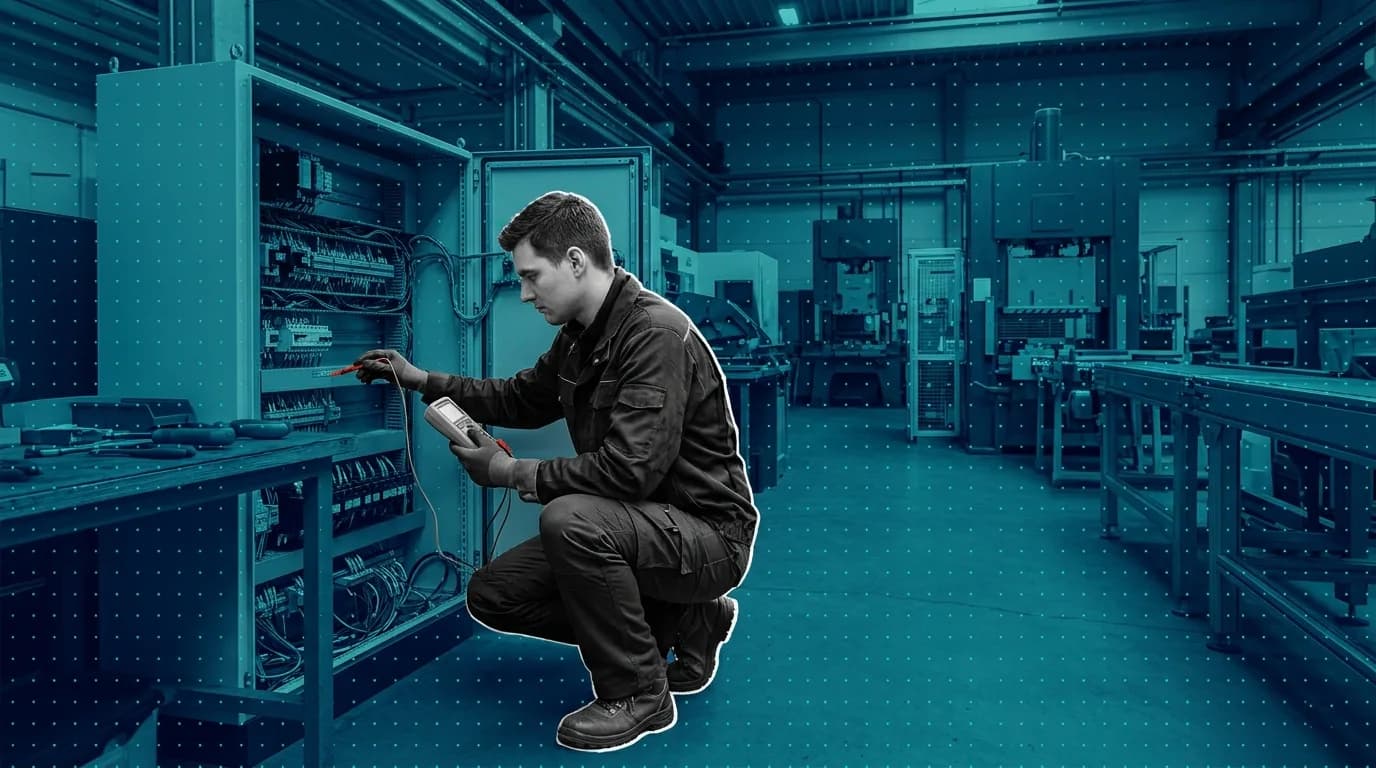

O&M stands for Operations and Maintenance — the day-to-day running of a facility or piece of equipment, plus the maintenance work that keeps it running. In a plant or facility context, O&M covers routine operation and monitoring together with scheduled and unscheduled repairs, tracked as one ongoing responsibility rather than a single project.
What O&M stands for
Say "O&M" on a plant floor or in a facilities contract and everyone nods. Ask them to define it precisely, and the room hedges — because O&M is short for Operations and Maintenance, and most people only need half the definition at a time.
Across manufacturing, facilities management, and construction, it has a fairly consistent core meaning: running something — a building, a utility system, a piece of production equipment — day to day, and maintaining it so it keeps running.
The abbreviation isn't exclusive to that world, though. Elsewhere, O&M stands for network operations in telecom, a line item in a government budget, orientation and mobility training for people with vision loss, and even an unrelated advertising agency (Ogilvy & Mather). None of those are what this page covers. Here, O&M means the operational and maintenance side of running a physical asset — which is how the term shows up in manufacturing plants, facilities contracts, and construction handover documents.
What O&M actually covers
O&M splits into two connected halves, and it's worth keeping them separate even though they're managed together.
Operations is keeping the asset running as intended, day to day. On a production line, that means starting and stopping equipment on schedule, monitoring utility consumption, keeping safety systems armed, and responding to alarms. On a building or facility, it's running the HVAC plant, managing security and access, and keeping consumables — fuel, water-treatment chemicals, filters — stocked so operations doesn't stop for something avoidable.
Maintenance is the work that keeps the asset capable of being operated at all — the preventive maintenance (PM) schedule, inspections, and the corrective repairs that come out of a breakdown or a failed inspection. This is the half most maintenance managers are already fluent in: work orders, PM plans, spare parts, downtime.
The two halves depend on each other. Operations generates the wear, the runtime hours, and the alarm history that a maintenance program schedules against. Maintenance keeps operations from being interrupted by equipment that's no longer capable of running the way it's operated. Treating them as one combined responsibility — instead of an operations team and a maintenance team working from separate records — is the whole point of calling it O&M rather than just "maintenance."
In practice, most plants already run both halves reasonably well on their own. The failure mode is rarely "we don't do operations" or "we don't do maintenance" — it's that the two live in different notebooks, run by different people, and nobody has read across them in a year. An operator logs a recurring alarm as routine. A technician sees the same asset failing more often than it used to. Neither one is wrong. Nobody's connected the two.
The O&M manual — and why it goes stale
On a construction or facility project, O&M usually shows up first as a specific deliverable: the O&M manual. It's the handover pack compiled at the completion of construction, explaining how the finished asset and its equipment are meant to be operated, inspected, and maintained — and handing it over is often a condition of practical completion and final payment, not an optional courtesy.
A proper O&M manual typically includes as-built drawings, an asset register, manufacturer's literature for the installed equipment, commissioning and test certificates, any statutory certificates, control-system settings, maintenance schedules, warranties, and a list of recommended spares.
Here's the honest part: an O&M manual is a snapshot of the asset at one moment — the day it was handed over. Equipment gets replaced with a different model. Maintenance intervals get revised based on actual failure history instead of the OEM's default recommendation. A control system gets reconfigured. None of that updates the original manual unless someone deliberately maintains it as a living document, and on most sites, nobody owns that job.
The binder itself usually survives fine. It sits on a shelf in the maintenance office or a folder on a shared drive, present and intact, exactly where the handover team left it. What doesn't survive is its accuracy. The manual that shows up in an audit five years later often describes a plant that no longer quite exists — a pump that's since been swapped for a different model, a PM interval that was quietly doubled after nobody saw a failure at the original one, a control panel that's been rewired twice. Accurate on the day it was written, and slowly wrong ever since, one small undocumented change at a time.
O&M vs AMC
O&M and an Annual Maintenance Contract (AMC) get used interchangeably in conversation, but they're not the same scope. An AMC is usually narrower: scheduled preventive maintenance and minor repairs for a specific piece of equipment or a defined group of assets, bought as its own contract. O&M is the broader ongoing responsibility — it covers the ongoing operation of a facility or system as well as its maintenance, and can include things an AMC never touches, like monitoring, cleaning, and utility management.
In practice, a large facility contract (a utility plant room, a whole building) is more likely to run under O&M. A single machine or a defined equipment group is more likely to be covered by a standalone AMC — and an O&M contract often has AMC-style scheduled maintenance nested inside it as one part of a bigger scope. For the full comparison, see our guide to annual maintenance contracts.
How O&M work actually gets tracked
The operations side of O&M — readings, alarms, consumable levels — tends to live in whatever monitoring or SCADA system already runs the equipment. The maintenance side is where most plants still run on paper, spreadsheets, or a system that was never built for a factory floor.
A CMMS is built for that half specifically. A recurring PM plan auto-dispatches the inspection and service tasks an O&M program depends on, on the interval the equipment actually needs rather than whenever someone remembers. When an inspection finds something, it becomes a work order with the parts used, downtime, and technician captured as required fields — not an optional note. Over time, that history becomes the living record an O&M manual is supposed to be but rarely stays: which parts fail early on which assets, which PM intervals are too conservative or too aggressive, and what an auditor needs to see when the paper manual is five years out of date.
It's a smaller shift than it sounds like. Nobody has to throw out the O&M manual or replace it with software on day one — the manual still does its job as the original reference. What changes is where the current truth lives: not in a document someone would have to remember to update, but in the record that gets written automatically every time the equipment is actually touched.
Where MachDatum fits: MachDatum's PM plans auto-dispatch the inspection and service work an O&M program runs on, and every work order that comes out of it — parts, downtime, technician — becomes part of a searchable asset history instead of a manual that goes stale the day it's handed over. We're onboarding our first group of manufacturing teams right now — see how it works at machdatum.com/cmms.
FAQ
What does O&M stand for? O&M stands for Operations and Maintenance — the combined responsibility of running a facility or piece of equipment day to day and maintaining it so it keeps running. It covers both the operational side (monitoring, utilities, day-to-day running) and the maintenance side (PM schedules, inspections, corrective repairs), tracked together rather than as two separate jobs.
What is an O&M manual? An O&M manual is the handover pack compiled when a construction project or major equipment installation is completed, explaining how the asset and its equipment are meant to be operated, inspected, and maintained. It typically includes as-built drawings, an asset register, manufacturer documentation, commissioning certificates, maintenance schedules, and warranty information — and handing it over is often a condition of final payment.
What's the difference between O&M and an AMC? An AMC (Annual Maintenance Contract) is narrower — scheduled preventive maintenance and minor repairs for a specific piece of equipment or asset group. O&M is broader: it covers the ongoing operation of a facility or system as well as its maintenance, and can include monitoring, cleaning, and utility management alongside the maintenance work. An O&M contract often has AMC-style scheduled maintenance nested inside it.
Does O&M always mean "Operations and Maintenance"? Not always — the abbreviation is reused across unrelated fields. It can mean network operations in telecom, a government budget line item, or orientation and mobility training for people with vision loss, among others. In a manufacturing, facilities, or construction context — what most people searching this term mean — O&M reliably means Operations and Maintenance.