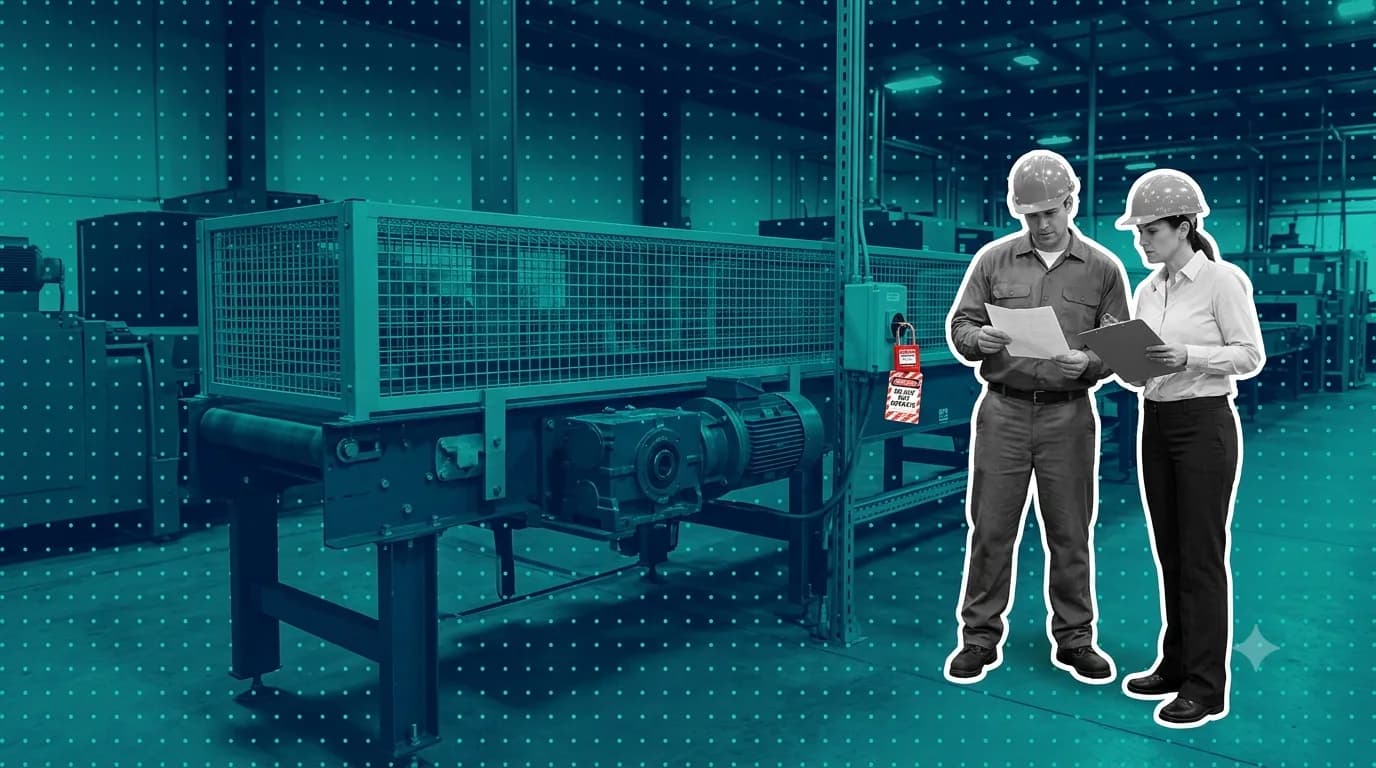



JSA stands for Job Safety Analysis: a written, step-by-step breakdown of a specific task that lists the hazard at each step and the control that removes or reduces it, completed before the work starts. It's also called a Job Hazard Analysis (JHA). The output is usually a three-column table: steps, hazards, controls.
What JSA stands for
In a safety context, JSA means Job Safety Analysis. OSHA calls the same thing a Job Hazard Analysis (JHA) and describes it as a technique that focuses on job tasks as a way to identify hazards before they occur, looking at the relationship between the worker, the task, the tools, and the work environment.
The abbreviation is reused elsewhere (autograph authentication, student associations, a UK benefit), but on a plant floor, construction site, or oil-and-gas lease, JSA reliably means the job safety analysis.
The key word is job. A JSA isn't a general assessment of an area or a department. It covers one task: changing a conveyor belt, clearing a jam on a press, replacing a hydraulic hose. It's broken into the steps someone actually takes to do it.
What a JSA contains
Most JSA forms, paper or digital, capture the same things:
- The job: one specific task, with the equipment and location named
- The steps: the sequence a worker actually follows, typically 5–10 steps
- The hazards at each step: what could hurt someone, and how
- The controls for each hazard: what will be done to remove or reduce it
- Who prepared and reviewed it, and the date
Here's what that looks like for a common maintenance job.
Example JSA: replacing a conveyor drive belt (illustrative — build yours from your own equipment and procedures)
| Step | Hazard | Control |
|---|---|---|
| 1. Stop the conveyor and isolate power | Someone restarts the conveyor while hands are inside the guard | Lock out and tag the motor isolator; try the start button to confirm it won't run |
| 2. Remove the drive guard | Heavy guard falls on hands or feet; sharp edges | Two-person lift, cut-resistant gloves, safety shoes |
| 3. Release belt tension | Stored tension in the tensioner snaps back | Back the tensioner off gradually; stand out of the line of release |
| 4. Remove the old belt and fit the new one | Fingers caught between belt and pulley | Never rotate the pulley by hand with fingers on the belt; use a bar to guide it on |
| 5. Re-tension and refit the guard | Over-tensioning damages bearings; guard left off | Tension to the manufacturer's spec; guard fully bolted before the lock is removed |
| 6. Remove lockout and test-run | Someone is still in the danger zone at startup | Verbal all-clear and visual check that everyone is clear before restoring power |
Notice that every control is specific. "Be careful" or "use caution" isn't a control. A control is something a person does or uses, and someone else could check whether it happened.
How to write a JSA, step by step
Sources disagree on whether it's four steps or five. The difference is mostly whether "review and communicate" counts as its own step. OSHA's own process starts even earlier, with involving the people who do the job. Here's the full sequence:
- Pick the job. Start with the jobs most likely to hurt someone (see the next section).
- Break it into steps. Watch someone do the job and write down each step as they take it. Keep it at the level of actions ("remove the guard"), not every hand movement. Too detailed and nobody reads it. Too broad and the hazards hide inside a single line.
- Identify the hazards at each step. Ask what could go wrong, how it would happen, and what the outcome would be: stored energy, pinch points, falls, heat, chemicals, electricity, heavy lifts.
- Define a control for each hazard. Work down the hierarchy: eliminate the hazard if you can, then engineer it out (guards, interlocks), then administrative controls (procedures, permits, training), and PPE last.
- Review it with the crew and keep it current. The technicians who do the job will spot missing steps faster than anyone. Review it again whenever something changes (more on that below).
The most important rule is the one OSHA spells out: involve the people who actually do the job. A JSA written at a desk by someone who has never done the task is the one that misses the step where people really get hurt.
Which jobs need a JSA
You can write a JSA for almost any task, but OSHA's guidance says priority should go to:
- Jobs with the highest injury or illness rates
- Jobs that could cause severe or disabling injury, even if nothing has happened yet
- Jobs where one simple human error could lead to a serious accident
- Jobs that are new, or where the process or procedure has changed
- Jobs complex enough to need written instructions
Read that list with a maintenance team in mind and most of it describes maintenance work. Production operators repeat the same task hundreds of times a shift. Maintenance technicians do non-routine, high-energy work on equipment that's been opened up, guards off, often under time pressure because the line is down. Those are exactly the conditions where a written analysis earns its keep.
JSA vs JHA vs risk assessment vs permit to work
These four terms get used interchangeably, and they aren't the same thing.
| What it is | Scope | When it's used | |
|---|---|---|---|
| JSA (Job Safety Analysis) | Step-by-step list of hazards and controls for one task | One job | Before a defined task, especially non-routine or high-risk work |
| JHA (Job Hazard Analysis) | Same as a JSA, under OSHA's name | One job | Same as JSA |
| Risk assessment | Identifies hazards and rates their likelihood and severity | An area, process, or activity | Broader planning; a JSA is one task-level form of it |
| Permit to work | Formal, signed authorization to start a specific high-risk job | One job instance, time-limited | Hot work, confined space, electrical isolation, work at height |
The simplest way to think about it: the JSA works out what the hazards and controls are. A permit to work is the go/no-go sign-off that those controls are actually in place before a high-risk job starts on a given day. Lockout/tagout is often one of the controls the JSA calls for and the permit checks.
Why JSAs fail in maintenance
Most plants that have a safety program have JSAs. The problem is rarely that the JSA doesn't exist. It's one of these:
It was written once and never touched again. The JSA was created during an audit push three years ago. The equipment has been modified, the procedure has drifted, and the document describes a job nobody does anymore.
It wasn't updated after a near miss. OSHA's guidance says to review the analysis whenever an injury or illness happens on that job, and to talk through close calls with everyone who does it. In practice, the incident report gets filed and the JSA stays as it was.
It isn't there when the job happens. This is the big one. The JSA lives in a binder in the safety office or a folder on a shared drive. The job lives on a work order on a technician's phone or clipboard. At 2 a.m., with the line down, nobody walks to the safety office first.
The controls are generic. "Wear appropriate PPE." "Follow lockout procedures." "Be aware of surroundings." Those lines can't be checked, so they don't change behavior.
Where a JSA connects to maintenance software
A JSA is a safety document, not a maintenance-planning tool. But the jobs that need a JSA most, recurring high-risk maintenance tasks, are the same jobs that already exist as work orders and preventive maintenance tasks in a CMMS.
That makes the fix for the "not there when the job happens" problem straightforward: put the JSA's controls where the technician already looks. In MachDatum, each job type carries its own checklist and instructions, and a preventive maintenance plan's checklist goes out on every work order the plan generates. So the key controls from the JSA (isolate and lock out, confirm zero energy, guard refitted before restart) become checklist steps in front of the person doing the work, and completing them leaves a record of who did what, and when. When the JSA is revised after a near miss, updating the plan's checklist means the next work order carries the new steps.
The same logic applies to other safety-critical routines, such as daily forklift inspections and fire safety checks. The check is only as good as whether it happens and gets recorded at the point of work.
If you're tracking maintenance jobs in spreadsheets and safety documents in binders, see how MachDatum CMMS handles work orders and checklists.