



A machine maintenance program is a system, not a single checklist: an asset list, a scheduled PM plan per machine, a defined breakdown-response process, and a record of what was done that survives staff turnover. Most plants have pieces of this. Few have all four connected. Here's what each piece needs, and where programs quietly stop running.
For the different categories of maintenance work itself — preventive, corrective, predictive, and the rest — see our types of maintenance guide; this piece is about assembling those categories into one working program.
What a machine maintenance program needs
Four things, and a program is only as strong as the weakest one:
- An asset list. Every machine that gets maintained needs to exist as a record somewhere — not "the press" or "line 3," but a specific asset with an ID. Without this, history doesn't accumulate anywhere useful; it scatters across whoever happened to work on the machine that week.
- A PM schedule per machine. Not one generic schedule for the plant — each machine type has its own failure modes and its own interval. See the per-machine-type detail below.
- A defined breakdown-response process. When something fails outside the schedule, who gets notified, who's authorized to work on it, and what gets recorded before the job closes. A program without this reduces to "someone deals with it" — which usually works, until the someone is on leave.
- A record that survives staff turnover. If the only place "what this machine usually needs" lives is in one technician's head, the program leaves when they do. Written procedures, logged history, and a next-due date that doesn't depend on memory are what make a program durable.
Building it by machine type
Generic maintenance advice treats all machines the same. They aren't. Two examples, worked in the same detail as our preventive maintenance checklist guide:
Hydraulic press. The failure modes that matter: hydraulic fluid degradation (check level and color monthly, not just level), seal wear at the ram (visual inspection for weeping), and pressure relief valve drift (quarterly set-point verification against the data plate spec). A program for a press without a lubrication point for the ram and slide guides, and without a documented pressure relief check interval, is missing the two items most likely to cause an unplanned stop.
CNC machining center. Different failure profile entirely: coolant contamination (concentration checked with a refractometer, not by eye), chip and swarf ingestion into linear guides and ballscrews (daily wipe-down on high-use machines), and thermal drift from skipping the warmup cycle before precision work. A program built around "monthly PM" alone misses the daily items — coolant and chip control — that actually drive most CNC downtime between monthly services.
The pattern: a machine maintenance program isn't complete when every machine has a PM schedule. It's complete when each machine's schedule reflects that specific machine's actual failure modes — not a template copied across the fleet.
Where programs break down in practice
The program on paper and the program that actually runs are two different things, and the gap between them is where most unplanned downtime comes from.
PMs slip and nobody notices for weeks. A schedule that lives in a spreadsheet or a wall calendar depends on someone actively checking it. When production pressure hits, the PM that was due Tuesday gets pushed — reasonably, once — and then again, and by the time anyone looks, it's been six weeks.
No single owner per machine. "Maintenance" as a department is responsible for everything, which in practice means no one machine has someone who notices when its pattern changes. A program needs an assignee, not just a team.
History exists but isn't reviewed. Work orders get closed, logs get filled in, and none of it gets looked at again until something fails and someone goes looking for what happened last time. A record that's never reviewed isn't doing the job a record is for — spotting the repeat failure before it repeats a third time.
None of this means the program was designed wrong. It means a program is only as good as whether it keeps running under real production pressure, not whether it looked complete the day it was written.
Of the four pieces, the durable record is the one I've seen missing most often. The other three usually exist in some form — an asset list, a schedule, even an informal breakdown process — but the history behind them is scattered across a technician's notebook, a shared drive folder, and someone's memory, instead of living in one place anyone can actually search.
How MachDatum supports this
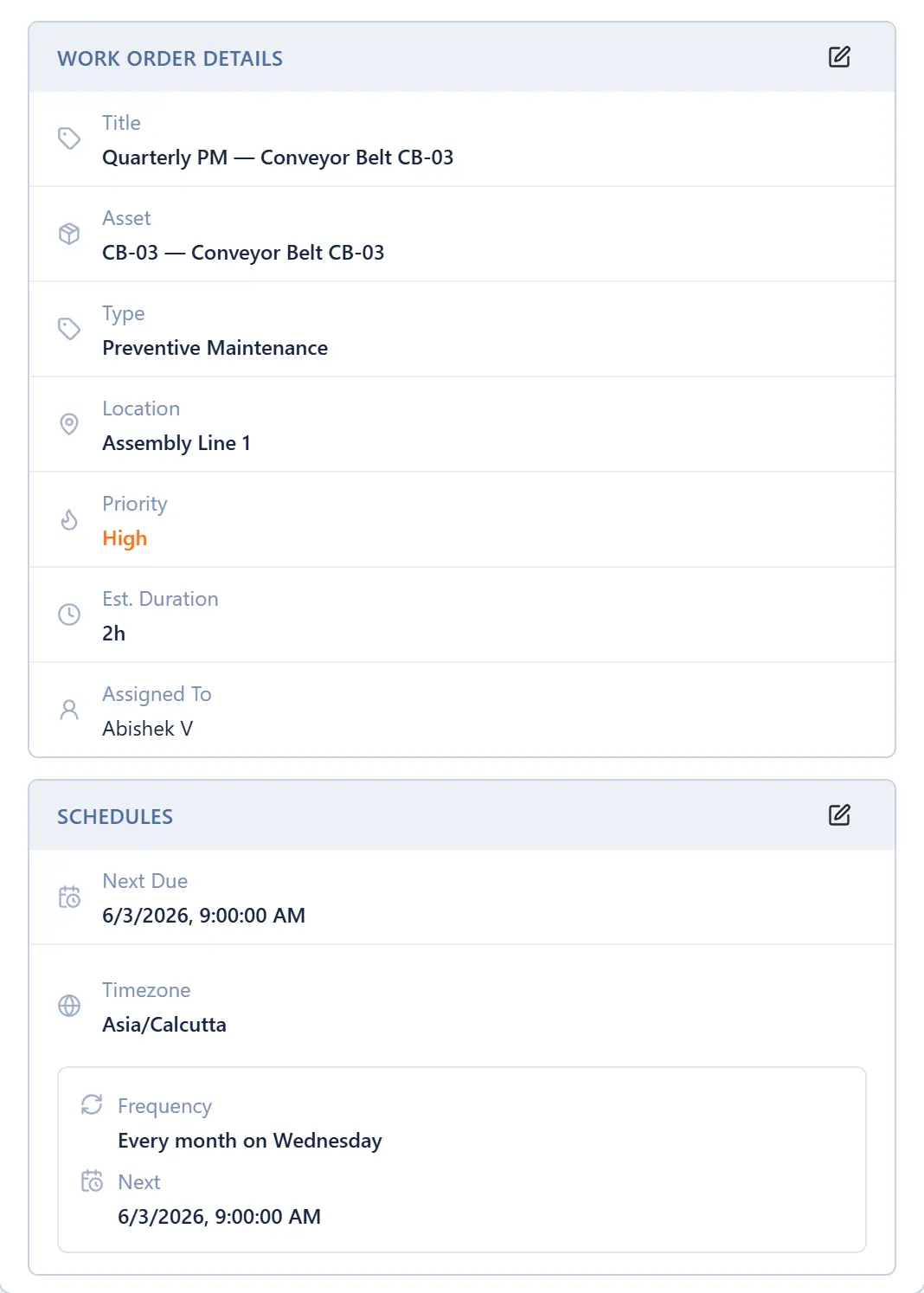
The four pieces above map directly to how MachDatum is structured: assets as first-class records, PM plans with auto-dispatch per machine (so a due schedule doesn't depend on someone checking a spreadsheet), configurable work order types for breakdown response with mandatory fields like root cause and downtime, and a full history attached to each asset — not a folder that only gets opened at audit time.
Where MachDatum fits: PM plans auto-dispatch on schedule instead of depending on someone remembering to check. Breakdown work orders capture root cause and downtime as mandatory fields before they can close. Every asset carries its full history — so the program doesn't depend on one technician's memory. We're onboarding our first group of manufacturing teams right now — see how it works at machdatum.com.