

A confined space permit, or entry permit, is the written authorization an employer issues before anyone enters a permit-required confined space. It records the hazards and how they're controlled, the atmospheric test results, who the entrants, attendant and entry supervisor are, and how rescue will be summoned. In the US the rule is OSHA 29 CFR 1910.146.
In a factory, almost every confined space entry is a maintenance job: cleaning out a tank or sump, clearing a blocked hopper, inspecting the inside of a silo, a boiler or a pressure vessel, replacing filter bags inside a dust collector, or working in a pit under a press. Those spaces aren't designed for people, and the permit exists because the things that make them dangerous are often invisible.
What is a confined space
OSHA defines a confined space with three conditions, and a space has to meet all three:
- It's large enough and configured so a person can bodily enter and do work
- It has limited or restricted means of entry or exit
- It's not designed for continuous occupancy
Plant examples: storage tanks, process vessels, silos, hoppers, bins, pits, sumps, vaults, ducts, boilers, dust collectors, large mixers and degreasers, and the inside of some large machines.
Being a confined space isn't enough to need a permit. That depends on what's inside.
Confined space vs permit-required confined space
A confined space becomes permit-required when it has one or more of these four characteristics (1910.146(b)):
- It contains, or could contain, a hazardous atmosphere (low oxygen, flammable gas or vapor, toxic gas, combustible dust)
- It contains material that could engulf an entrant (grain, sand, powder, liquid)
- Its internal shape could trap or asphyxiate someone, such as walls that converge inward or a floor that slopes down to a narrow point
- It has any other recognized serious safety or health hazard (moving parts, hot surfaces, electrical hazards, noise)
| Confined space (non-permit) | Permit-required confined space | |
|---|---|---|
| Meets the 3-part definition | Yes | Yes |
| Serious hazard present or possible | No | Yes, one or more of the four |
| Written entry permit | Not required | Required before every entry |
| Attendant outside | Not required | Required |
| Atmospheric testing | Good practice | Required before entry and as needed during |
| Rescue plan | Good practice | Required |
The classification isn't fixed. A clean, empty tank might be non-permit until someone brings a solvent inside to clean it or starts welding in it. Then it's a permit space. OSHA also requires employers to tell employees which spaces are permit spaces, by posting danger signs or another equally effective method (1910.146(c)(2)).
What a confined space entry permit includes
Paragraph (f) of 1910.146 lists what the permit must identify. In plain terms:
- The space to be entered and the purpose of the entry
- The date and authorized duration
- The authorized entrants (by name, or by a tracking method that shows who is inside)
- The attendants and the entry supervisor, with the supervisor's signature authorizing entry
- The hazards of the space
- The isolation and control measures used before entry: lockout, blanking or bleeding lines, purging, ventilation
- The acceptable entry conditions
- The atmospheric test results, with the tester's initials and the time of the tests
- The rescue services and how to summon them
- The communication method between entrants and attendants
- The equipment provided: PPE, test instruments, communication equipment, alarms, rescue equipment
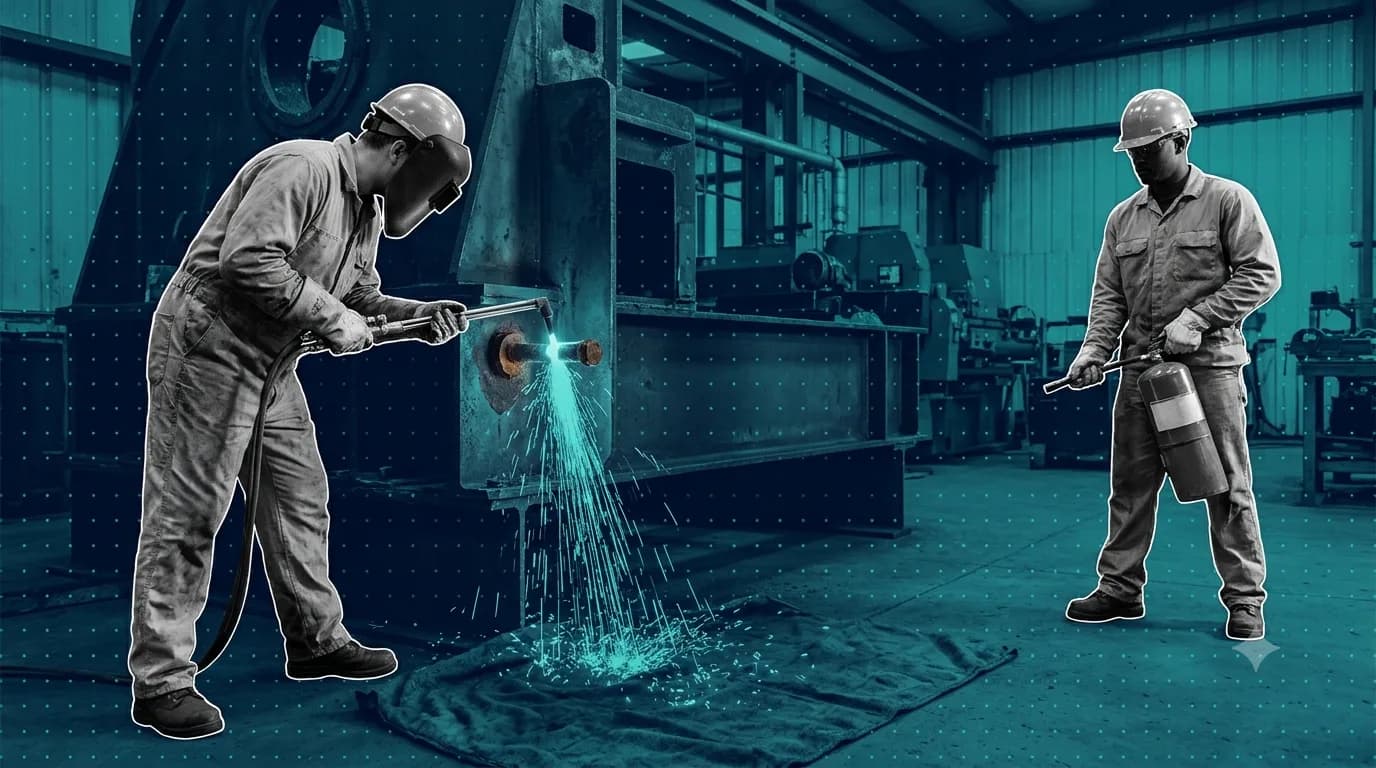
- Any additional permits issued for work in the space, such as a hot work permit
Atmospheric testing follows a set order: oxygen first, then combustible gases and vapors, then toxic gases and vapors (1910.146(d)(5)(iii)).
A copyable permit layout
If your site doesn't have a form yet, this layout covers the items 1910.146(f) requires. Adapt it to your written permit space program.
| Section | What to record |
|---|---|
| Space and job | Space ID and location, asset or equipment, purpose of entry, work order number |
| Time | Date, start time, expiry (no longer than the task) |
| People | Authorized entrants, attendant(s), entry supervisor |
| Hazards | Atmospheric, engulfment, configuration, mechanical, electrical, thermal, other |
| Isolation and controls | Lockout points, lines blanked or bled, purging, ventilation method |
| Atmospheric tests | O₂ %, LEL %, toxic gases (ppm), time, tester initials. Pre-entry and periodic |
| Rescue | Rescue service, how to summon, retrieval equipment in place |
| Communication | Method between entrant and attendant (voice, radio, signal line) |
| Equipment | PPE, gas detector, harness, tripod and winch, lighting, alarms |
| Other permits | Hot work permit number, if any |
| Sign-off | Entry supervisor authorizes entry · cancels permit at end of job (keep for one year) |
The three roles: entrant, attendant, entry supervisor
- Authorized entrant. Goes into the space. Knows the hazards, uses the equipment, stays in contact with the attendant, and gets out when told to or when something changes.
- Attendant. Stays outside the space for the whole entry, keeps count of who's inside, monitors conditions, and calls rescue. The attendant doesn't go in to attempt a rescue unless trained and relieved by another attendant.
- Entry supervisor. Checks that the acceptable entry conditions are met, signs the permit, and ends the entry and cancels the permit when the job is done or conditions change.
One person can hold more than one role, such as entry supervisor and attendant, if properly trained for each. Rescue is a fourth piece. OSHA 1910.146(k) requires employers to make sure a rescue service can respond in time and is equipped and trained for the spaces involved. Rescue teams have to practice simulated rescues at least every 12 months.
How long a permit is valid
There's no fixed number of hours. Under 1910.146(e)(4), the permit can't last longer than the time needed to finish the task written on it. Many sites cap it at one shift on top of that.
The entry supervisor cancels the permit when the work is done or when something comes up that the permit doesn't allow, such as a gas alarm, a change in the work, or a nearby process that could affect the space. Canceled permits are kept for at least one year (1910.146(e)(6)), and the program is reviewed using them.
Construction work has its own confined space standard, 29 CFR 1926 Subpart AA. This post covers general industry, meaning factories and plants.
Confined space, LOTO and hot work: how they stack up
A single maintenance job inside a confined space often needs several controls at once. Take replacing a worn agitator blade inside a mixing tank:
- A job safety analysis identifies the hazards: residual product, the agitator motor, low oxygen if the tank was purged with nitrogen, and the weld repair on the blade mount.
- Lockout/tagout isolates the agitator drive and the inlet and outlet lines before anyone goes in.
- The confined space permit covers the entry itself: atmospheric tests, ventilation, attendant, rescue.
- A hot work permit covers the welding inside the tank, and is listed on the entry permit.
All of them sit under the site's permit to work system. The danger is that each lives on a different piece of paper.
Why confined space permits fail in maintenance
Spaces aren't identified ahead of time. The permit space inventory is a list in the safety manual, not something attached to the tank or pit itself. When a breakdown happens, the technician who's sent to fix it doesn't know the sump is a permit space.
The permit is filled out at the hatch. Atmospheric tests are done, the form is signed, and entry starts. But the isolation, the lockout, and any hot work inside are recorded somewhere else, or not at all. Nobody can see the whole job in one place.
The attendant gets pulled away. The job runs long, the attendant is needed elsewhere, and the person inside is left without anyone watching the opening. That's exactly the gap the attendant role exists to close.
Rescue is assumed, not arranged. "We'll call the fire department" isn't a rescue plan unless someone has confirmed they can respond in time and have the equipment for that specific space.
Breakdown jobs skip the process. A blocked hopper is stopping the line, and the quickest fix is to climb in and clear it. Emergency jobs are where the permit matters most and where it's most often skipped, just like the breakdown maintenance shortcuts that cause repeat failures.
Where confined space work connects to maintenance software
A confined space permit is a safety authorization. Software doesn't replace atmospheric testing, an attendant at the hatch, or a rescue team that can actually get there. But the jobs that need confined space entry are maintenance work orders on known assets and locations, and that's where the information belongs.
In MachDatum, each job type can carry its own checklist, and work order workflows are configurable, with role-gated transitions and mandatory fields. Assets and locations can carry your own attributes, so a tank or pit can be marked as a permit space on its record. The entry checks (permit number, atmospheric readings, isolation points, attendant named, rescue confirmed) can sit on the work order the technician already has, and the completed record stays with the asset's history.
If your permit space list lives in a binder and your maintenance jobs live in a spreadsheet, see how MachDatum CMMS handles assets, work orders and checklists.