


A maintenance supervisor coordinates the day-to-day work of a maintenance team — assigning jobs, tracking what's overdue, making sure PMs happen on schedule, and stepping in when a breakdown needs an immediate call. It's a hands-on coordination role, not a purely administrative one. Written for the plant or facilities manager doing the hiring, or defining the role for the first time.
What a maintenance supervisor is responsible for
- Assigning and prioritizing work across the team — deciding which of today's open jobs actually needs to happen first
- Tracking PM schedule adherence — knowing what's due, what's overdue, and why
- First response coordination on breakdowns — who gets called, who's authorized to work on what
- Technician oversight — training, scheduling, and day-to-day supervision of the maintenance crew
- Reporting up — giving the plant manager or maintenance manager an honest read on equipment condition and team capacity, not just "everything's fine"
The role is operational, not strategic. A maintenance supervisor is in the middle of the work every day — the person who knows, at any given moment, what's actually going on across the floor.
Maintenance supervisor vs. maintenance manager — what's the difference
These titles get used loosely, and at smaller plants the same person often does both. Where a distinction exists:
A maintenance manager sets the strategy — budget, PM program design, staffing levels, vendor relationships, and long-term reliability planning. A maintenance supervisor executes it day to day — assigning the work, coordinating the team, and being the first point of contact when something goes wrong on shift.
The practical test: if the question is "what should our PM strategy be for the next year," that's a manager question. If the question is "who's free to take the breakdown on line 3 right now," that's a supervisor question. Plants under a certain size often combine both into one role; larger operations usually split them once the coordination workload alone becomes a full-time job.
What makes a good maintenance supervisor
Beyond technical maintenance knowledge — which matters, but isn't the differentiator most plants assume it is — the traits that actually separate a strong supervisor from a weak one:
Triage judgment. On any given day, there are more open jobs than time to do them. A good supervisor can look at the list and correctly identify which two or three actually matter, instead of working whatever's loudest or newest.
Honest status reporting. The supervisor who tells the plant manager "we're behind on PMs for line 2 and here's why" is more valuable than the one who says everything's fine until a breakdown proves otherwise. This is a character trait as much as a skill, and it's worth probing for directly when hiring.
Comfortable delegating, not just doing. Technicians who get promoted into supervisor roles sometimes keep doing the hands-on work themselves because it's familiar, and the coordination work — the actual job — suffers. A good supervisor delegates the wrench work and spends their time on the coordination that only they can do.
Interview questions to ask when hiring one
"Walk me through how you'd prioritize five open work orders if you only had time for two today." Listen for a reasoning process — safety first, production-impact second, everything else after — not just a list. A candidate who can't articulate why one job beats another hasn't actually been doing triage; they've been doing whatever was in front of them.
"Tell me about a time a PM schedule slipped on your watch. What happened, and what did you do about it?" Every real supervisor has a story here. The answer that matters is what they did next — not whether it happened at all.
"How do you decide when to escalate a problem versus handle it yourself?" Tests both technical judgment and whether they understand their role includes knowing when something is above their authority or capacity to fix alone.
"What would you want visibility into on day one that you don't have now?" A strong candidate has already thought about what they need to see — overdue jobs, technician workload, recurring failures — to do the job well. A weak answer is vague or focused entirely on tools they've used before rather than what they actually need.
In my own experience hiring and working alongside supervisors, the strong ones are the ones who prioritize with production in mind, not just maintenance. They understand what the line actually needs today, not just which machine is broken, and triage accordingly — that's a harder judgment call than it sounds, and it's the one weaker hires consistently get wrong.
What tools a supervisor needs to actually do the job
The best supervisor in the world is still guessing if they can't see the full picture: what's overdue across the team, who's already at capacity, and which machine has failed the same way twice this quarter. A supervisor working from memory and a whiteboard is coordinating blind — not because they lack skill, but because the information they need to make good calls doesn't exist anywhere they can see it at a glance.
This is the gap that shows up most often once someone steps into the role: the job requires real-time visibility across the whole team's workload, and most plants hand a new supervisor exactly the tools their predecessor had — a spreadsheet and a radio.
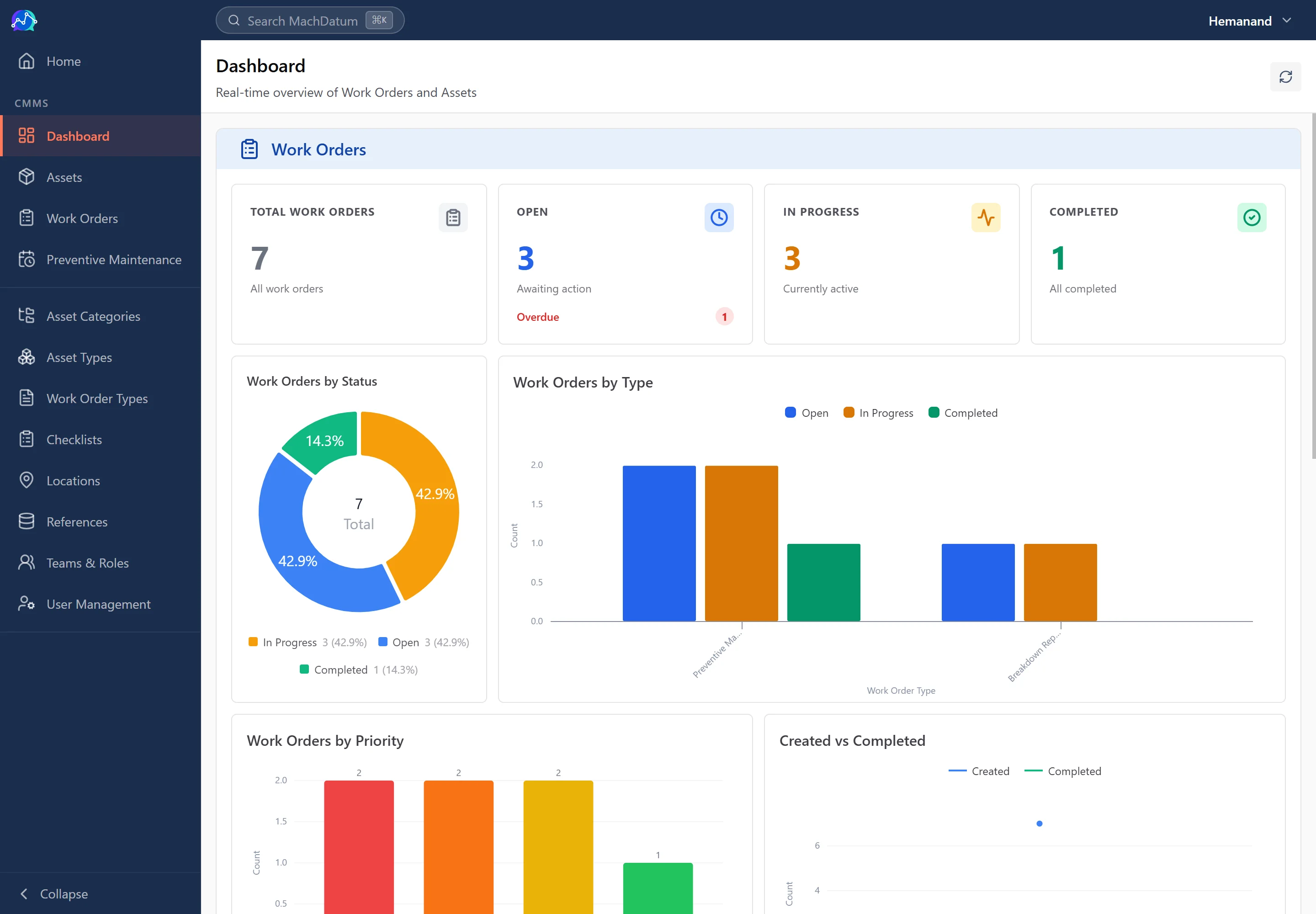
Where MachDatum fits: a supervisor's dashboard shows open work orders by priority, overdue PMs by asset, and technician workload at a glance — the exact visibility the interview question above is testing for. Assigning a job, checking who's free, and seeing what's slipped are one screen, not a walk around the floor or a phone call. We're onboarding our first group of manufacturing teams right now — see how it works at machdatum.com.
For the roles that work alongside a supervisor day to day, see our guides to the maintenance planner and what a maintenance technician does on a manufacturing floor.