
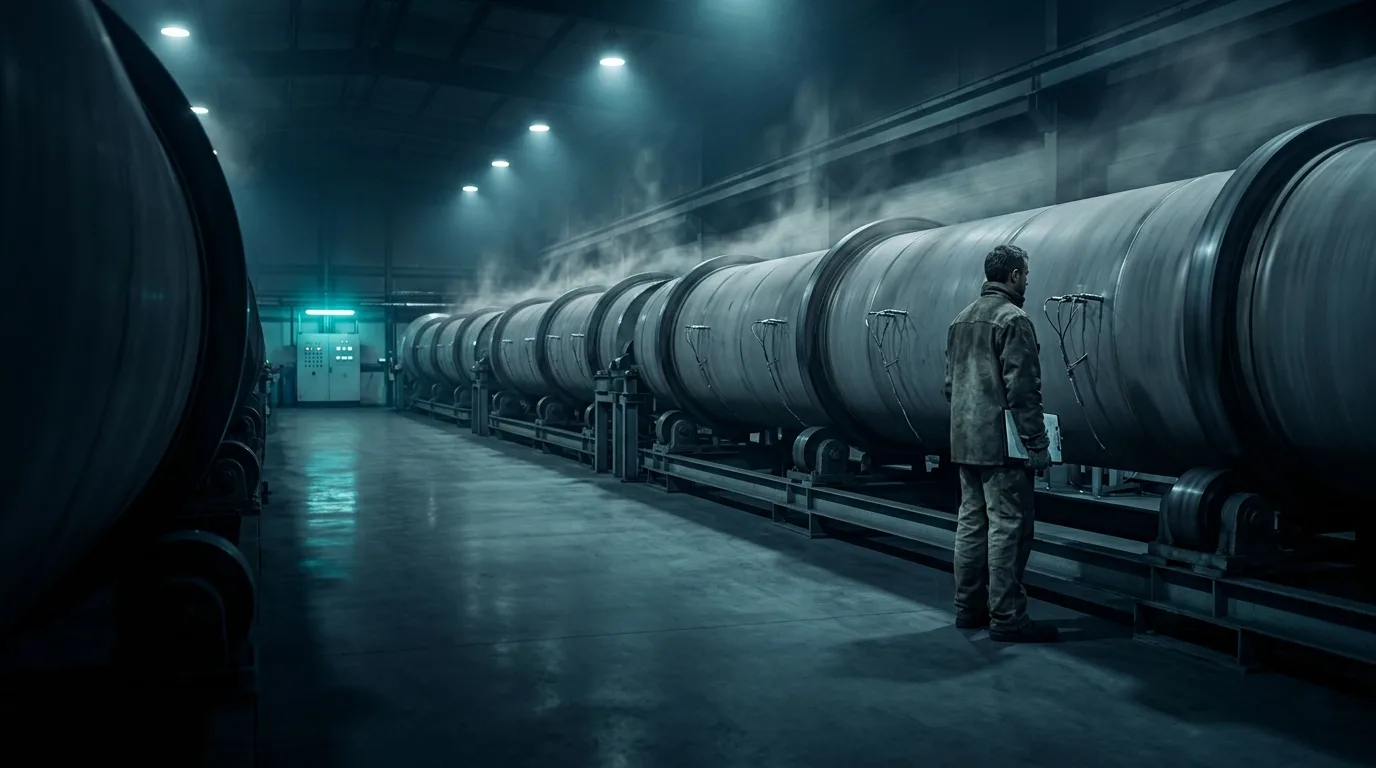
Every thirty minutes, someone had to walk into the heat and wait.
Thirteen rotary kilns across three units, four thermocouple points on each, a reading due every thirty minutes — and every one of them taken by a person standing in the heat, waiting for the rotating drum to bring the point back round.
- manual readings eliminated every day
- 2,496manual readings eliminated every day
- rotary kilns across three units
- 13rotary kilns across three units
- reading interval the manual process could not hold
- 30 minreading interval the manual process could not hold
- ambient heat operators no longer stand in
- ~80°Cambient heat operators no longer stand in
The daily arithmetic
readings a day across three units, every one of them written down by a person
The process wants a temperature every thirty minutes, on four points, on each of thirteen kilns — seven at one unit and three at each of two others. That is what the product needs. These kilns turn coconut shell into activated carbon, and activation is purely a thermal process, so the readings are the only evidence it is happening correctly.
These are rotary kilns. The measurement points turn with the drum, so an operator could not simply walk up and take a reading — they had to stand in the heat and wait for the point to come back round. Forty-eight times a day, across fifty-two points. It was never going to hold, and the entries that did get made could not be relied on.
A temperature drift spoils the entire batch — and nobody can tell until the process has finished.
That is what makes the gaps expensive. There is no in-process inspection that catches this and no way to pull a bad batch back once it has run; the kiln either held its profile or it did not, and you learn which at the end. Every skipped round was a stretch of time in which a batch could already have been lost, with the evidence never written down.
Why it had not already been automated
Nobody at this plant wanted people doing this. The reason it was still manual is that each obvious solution creates the next problem.
- 01
You cannot run a cable to something that rotates
The measurement points turn with the drum. Any wired instrument means a cable that has to survive continuous rotation next to a furnace, which is not a design problem so much as a countdown. Wireless was not a preference here — it was the only option on the table.
- 02
So it has to carry its own power
No cable means no supply. The node runs on EV-grade Panasonic cells specified for high-temperature service, because an ordinary battery pack bolted to a kiln shell is a hazard rather than a power source. The pack is field-swappable in seconds — if replacing a cell were a job, the whole design would have traded one manual round for another.
- 03
And then the electronics have to survive the thing they are measuring
Sealing an enclosure against dust and washdown is straightforward. Keeping the inside of that sealed box cool, while it is mounted to a rotating surface radiating heat into it continuously, is the part that decides whether the system lasts a week or a decade.
The part that decides everything
A box, inside a box, bolted to a furnace
The electronics sit in an IP65 enclosure — that part is ordinary. What is not ordinary is that the enclosure is mounted to a rotating kiln shell radiating heat into it continuously, and the cells inside have a temperature ceiling.
So we built a second enclosure around the first: two skins of stainless steel sheet with glass wool packed between them. Stainless rather than mild steel, chosen for its lower thermal conductivity — the jacket exists to resist heat crossing it, and mild steel would move roughly three times as much for the same wall.
It is an unglamorous piece of sheet metal work. It is also the difference between a sensor that survives on a kiln and one that does not, which is most of the reason this had stayed a manual job.
Kiln shell · radiant heat
Stainless steel · outer skin
Glass wool · insulation
Stainless steel · inner skin
IP65 sealed enclosure
Transmitter electronics
- Thermocouple interface
- Arduino Nicla Sense · BLE
- EV-grade Panasonic cells · swappable
Follow one reading
A single temperature leaves a thermocouple on a turning drum and ends up in an SAP record. Four handoffs, and no person in any of them.
On the drum
Transmitter node
Interfaces directly with the thermocouple and rotates with the kiln. An Arduino Nicla Sense carries the BLE link; the EV-grade cells carry the node.
Off the drum
Receiver unit
An Arduino Portenta H7 takes up to twelve transmitters, processes their readings and publishes over MQTT. Wi-Fi or Ethernet, mains or battery — whichever the position allows.
Platform
Ingestion and history
MQTT into TimescaleDB, built for time-series at this cadence, with dashboards, reports and autonomous abnormality detection layered on top.
Enterprise
Pushed into SAP
Readings are posted to the client’s SAP system over REST endpoints. The data arrives where the business already works instead of waiting to be fetched from ours.
What changed
2,496 readings a day, taken by nobody
At the first unit alone that accounted for 22 workman-days per day, returned to work that actually needs a person standing there.
The 30-minute cadence, finally held
The process wants a reading every half hour on every point. It now gets one, on all fifty-two, without anyone deciding whether this round can be skipped.
Drift caught during the batch, not after it
An out-of-band reading raises an alert while the kiln is still running. That is the difference between correcting a profile and writing off everything in the drum.
Exposure designed out, not reduced
Nobody walks into roughly 80°C ambient heat to collect a number any more. The job was removed rather than made safer.
Data that reaches the business
Readings land in SAP over REST, so downstream processes consume them directly instead of a monitoring tool holding them in isolation.
A design that travels
The same architecture is now being deployed at a second manufacturer. The engineering was specific to the problem, not to the plant.
Why this kind of project shaped our product
Projects like this are where our instincts about equipment data came from: that a reading nobody acts on is not monitoring, that an alert has to reach a person before the problem reaches the product, and that data is only useful once it lands in the systems a plant already runs on.
They are also where we learned that the hard part is rarely the software. Here it was a jacket of stainless steel and glass wool.
The client is not named on this page. The work, the numbers and the technical detail are described exactly as delivered.
Something on your floor still measured by hand?
If the reading matters and the environment makes it awkward, that is usually the case for building something. Tell us what you are measuring today, and what makes it hard.
- An engineer reads it, not a sales queue.
- We reply within one business day.
- If it is not worth building, we will say so.
Prefer email? hemanand@machdatum.com