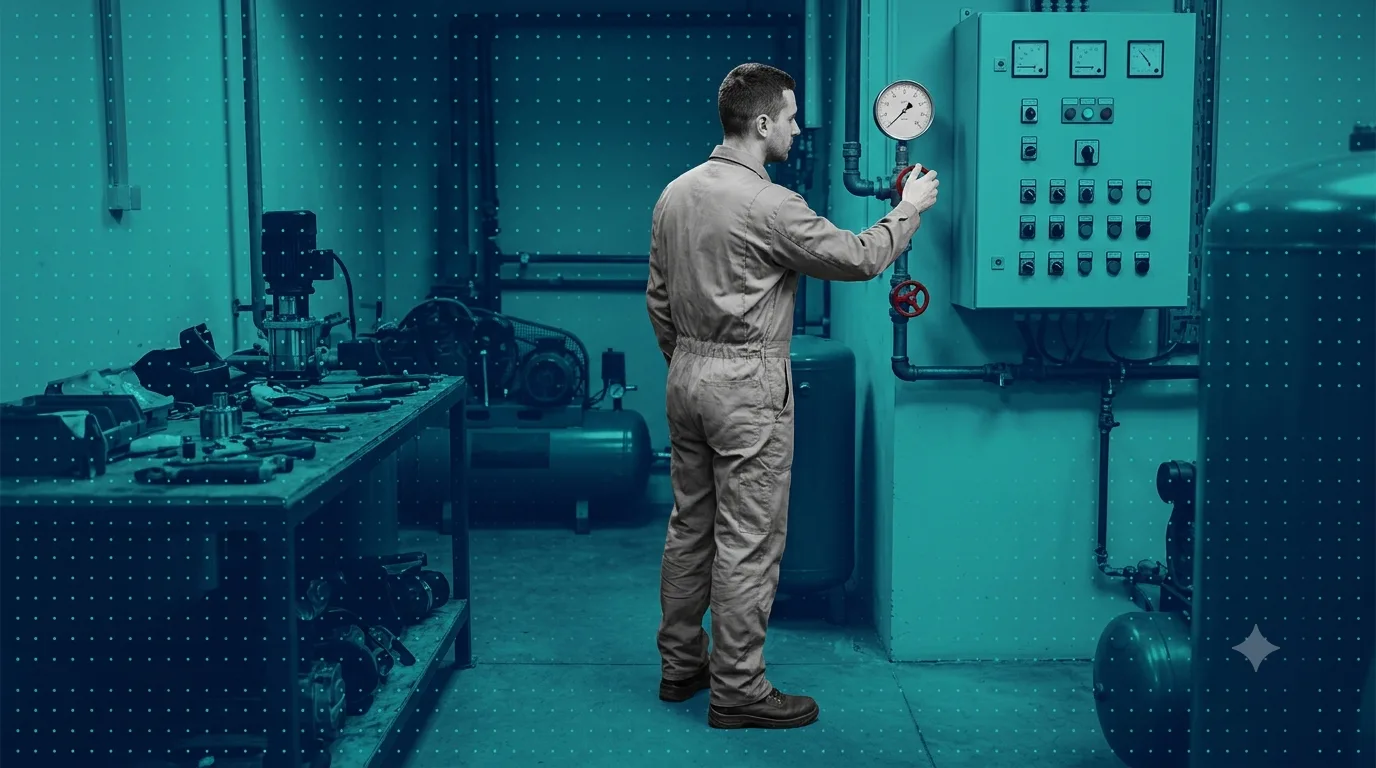

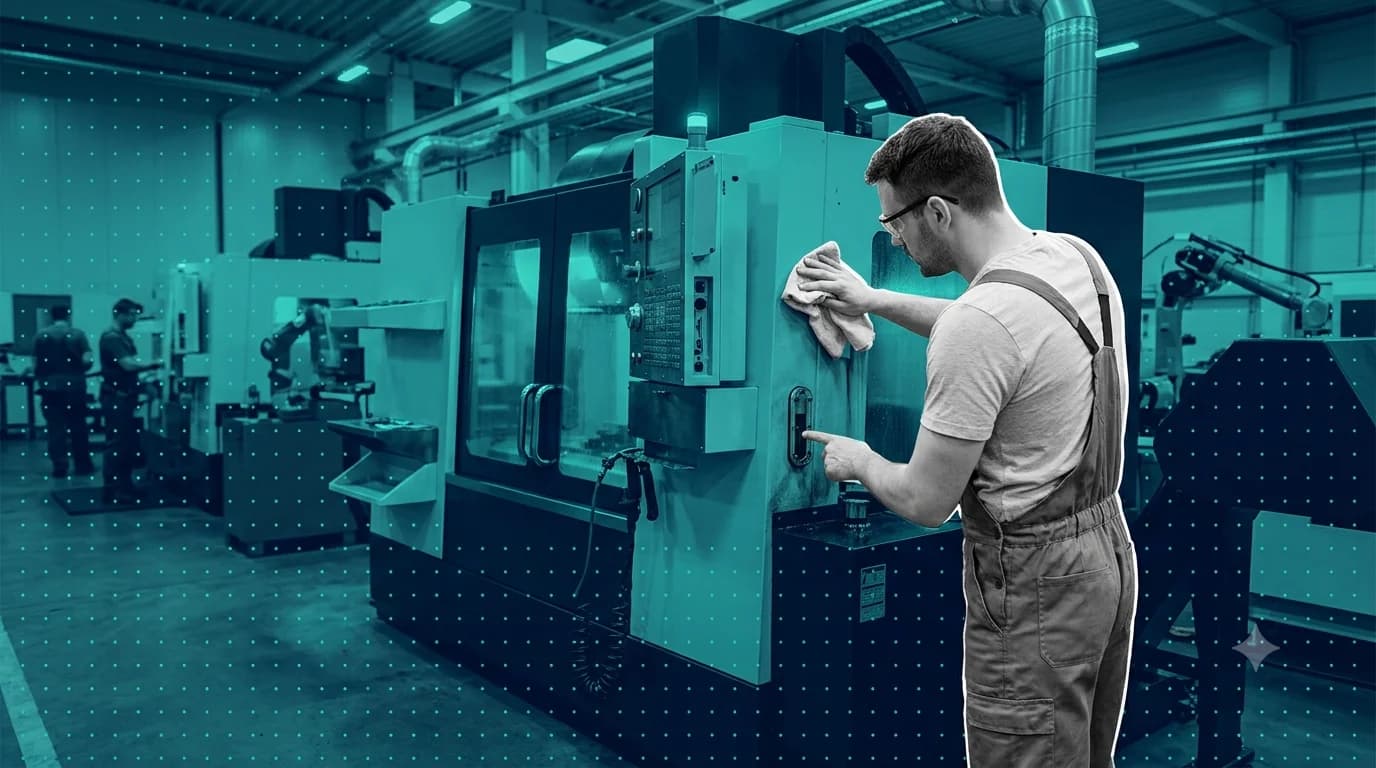

TPM stands for Total Productive Maintenance. It is a way of running a factory where operators, technicians, and managers share responsibility for keeping machines healthy — instead of leaving maintenance to a separate department that gets called after the breakdown. The goal: zero breakdowns, zero defects, zero accidents.
The "total" is the point. Not total as in "a lot of maintenance" — total as in everyone. The operator who runs the lathe cleans it, inspects it, and catches the loose bolt before it becomes a spindle failure. The maintenance team stops firefighting and starts preventing. Management measures what matters.
Where did TPM come from?
TPM was formalised in Japan in 1971 at Nippondenso, a Toyota group supplier, and its principles were developed and spread by Seiichi Nakajima of the Japan Institute of Plant Maintenance (JIPM). The problem it solved is one every plant still recognises: as machines became more automated, a separate maintenance department could no longer keep up. The people closest to the machines — the operators — had to become the first line of defence.
It worked well enough that JIPM has been auditing and awarding TPM excellence to plants worldwide for five decades, and TPM became one of the foundations of the Toyota Production System. In India, TPM has deep roots — CII's TPM Club of India has been guiding plants through JIPM-style implementations since the 1990s, and a long list of Indian plants hold JIPM TPM Excellence Awards.
We built a custom autonomous-maintenance system for a wind-energy component plant in Coimbatore, and the first thing it surfaced wasn't a fault — it was a standoff. Production wouldn't release machines for maintenance; maintenance couldn't move without inputs only the operators had; and a recurring breakdown sat in that gap, each side certain it was the other's job. Once operators were running the daily checks themselves, the pattern flipped — small problems showed up early on the five-minute round, instead of waiting to become the expensive repair nobody wanted to stop the line for.
What are the 8 pillars of TPM?
TPM implementations are built on eight pillars, usually standing on a foundation of 5S (a clean, organized workplace makes abnormalities visible).
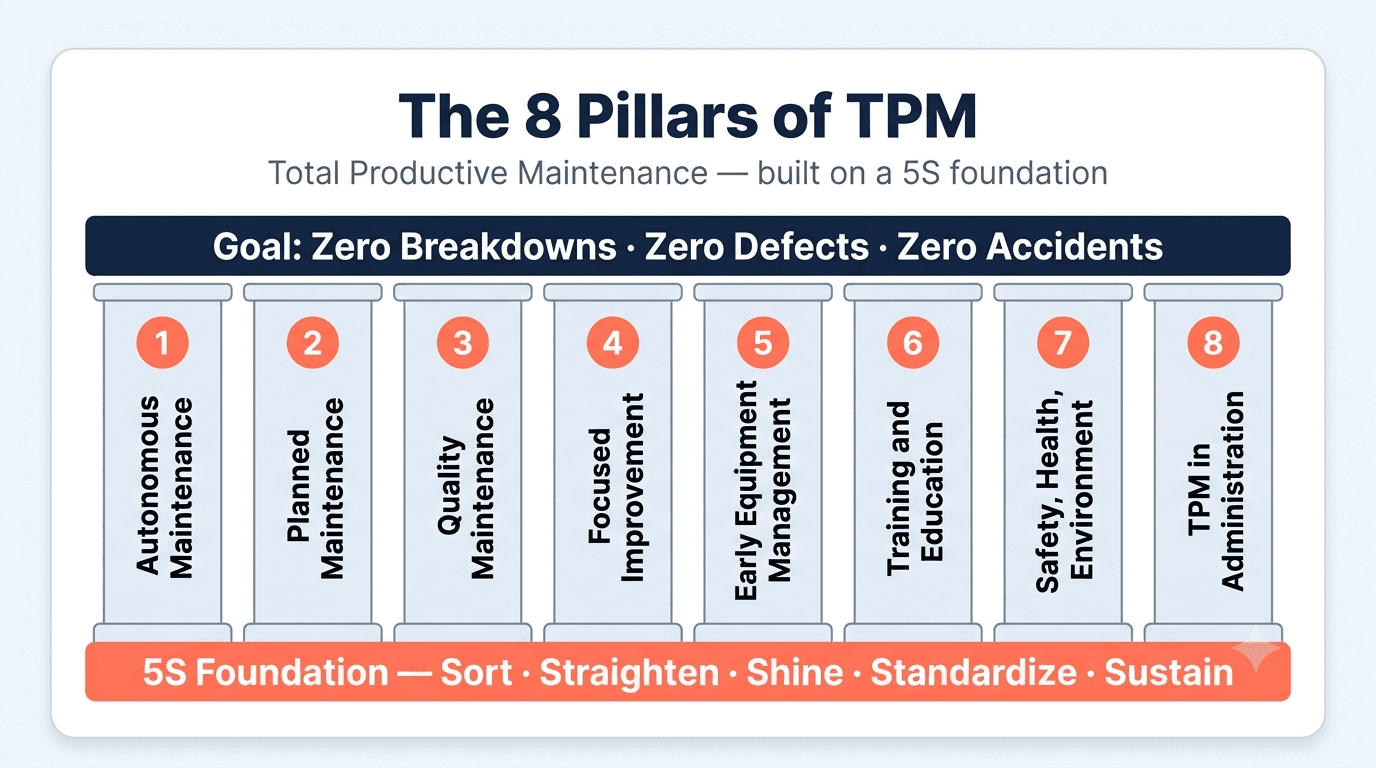
| Pillar | What it means on the floor |
|---|---|
| 1. Autonomous maintenance | Operators own routine care: cleaning, lubrication, inspection, tightening |
| 2. Planned maintenance | Scheduled preventive work based on failure history — not "fix it when it breaks" |
| 3. Quality maintenance | Detect and prevent the equipment conditions that create defects |
| 4. Focused improvement | Small cross-functional teams attack the biggest recurring losses |
| 5. Early equipment management | New machines designed/installed using lessons from the existing ones |
| 6. Training and education | Operators who can spot abnormalities; technicians who can prevent them |
| 7. Safety, health, environment | Zero accidents — an unsafe plant cannot be a productive one |
| 8. TPM in administration | The same waste-elimination logic applied to planning, scheduling, procurement |
Most plants that "do TPM" actually run two pillars — autonomous maintenance and planned maintenance. That's not failure; that's the right starting point. The other six build on those two. What each one looks like once it's actually running, not just named:
- Autonomous maintenance — the operator's daily five-minute round: clean, inspect, lubricate, tighten. The point isn't the cleaning itself; it's that a clean machine makes a leak or a loose bolt visible before it becomes a breakdown.
- Planned maintenance — PMs scheduled off failure history and OEM intervals, not off whoever remembers. If your PM calendar lives in someone's head, it isn't planned maintenance yet.
- Quality maintenance — the equipment conditions (wear, temperature, alignment) that produce defects get tracked and corrected before the defect ships, not after a customer complaint.
- Focused improvement — a small team, one recurring loss, root-caused and fixed. Not a suggestion box; a specific team on a specific number.
- Early equipment management — the breakdowns and awkward-to-service points on the current line get fed back into how the next machine is specified and installed.
- Training and education — operators trained to notice abnormalities, technicians trained to act on them before they become failures. Skipped constantly because it doesn't show up on this month's downtime report.
- Safety, health, environment — zero accidents as a precondition, not an add-on. A plant that's cutting corners on guards isn't going to be honest about breakdown data either.
- TPM in administration — the same discipline (checklists, visible backlogs, no tribal knowledge) applied to spares procurement and maintenance scheduling itself.
The two that actually move the needle for most plants are 1 and 2. Pillars 5 and 8 matter at scale, but a plant that hasn't nailed autonomous and planned maintenance yet doesn't have an early-equipment-management problem — it has a "nobody owns the checklist" problem.
How is TPM measured? (OEE)
TPM's headline metric is Overall Equipment Effectiveness (OEE) — see our full guide to OEE in manufacturing. It multiplies three things:
OEE = Availability × Performance × Quality
A worked example from one machine, one shift:
| Factor | Calculation | Result |
|---|---|---|
| Shift time | 8 hours planned | 480 min |
| Downtime (breakdown + changeover) | 45 + 15 min | 60 min |
| Availability | (480 − 60) ÷ 480 | 87.5% |
| Ideal output at rated speed | 420 min × 2/min | 840 pieces |
| Actual output | 720 pieces | |
| Performance | 720 ÷ 840 | 85.7% |
| Good pieces | 720 − 18 rejects | 702 |
| Quality | 702 ÷ 720 | 97.5% |
| OEE | 0.875 × 0.857 × 0.975 | 73.1% |
Nakajima's classic benchmark for "world class" is 85%. But the honest use of OEE isn't chasing a number — it's that the calculation forces you to see where the loss is. In this example the biggest leak is availability: a 45-minute breakdown. That's a maintenance problem, and it's exactly what TPM exists to attack.
What does TPM look like in practice?
A realistic autonomous-maintenance loop, stripped of consultant language:
- Operator runs a daily checklist — 5 minutes: oil level, abnormal noise, loose guards, leaks.
- Anything abnormal becomes a work order — not a verbal mention to whoever walks past. Logged, assigned, visible.
- Maintenance handles what operators can't — the planned, scheduled work: alignments, replacements, calibrations.
- Recurring failures get a root-cause review — a why-why analysis on anything that's happened twice.
- The numbers close the loop — breakdown counts, MTTR and MTBF trends per machine, reviewed monthly.
The hard part is not designing this loop. It's keeping it alive after week three.
Why do TPM programs fail?
An honest section, because most do fail — and usually the same way:
- The checklists are paper. Operators tick boxes nobody reads. After a month, they tick them in batches at shift end. After two months, they stop. Nobody notices until the audit.
- Abnormalities go nowhere. An operator reports a noise; nothing happens; the operator learns reporting is pointless. Autonomous maintenance dies right there — not from laziness, from a broken feedback loop.
- No baseline numbers. If you can't see breakdown frequency per machine before TPM, you can't show progress after — and management pulls support around month six when the costs are visible and the benefits aren't measured.
- It launches as a slogan. Banners, kickoff meeting, no change to who does what on Monday morning.
The fix for the first three is the same: the checklist results, the abnormality reports, and the numbers have to live in a system someone actually looks at — with overdue work visible and escalating, not buried in a register on a shelf.
Here's the opinion most TPM consultants won't sell you: most Indian plants don't need pillar 5 or pillar 8. They need pillars 1 and 2 — autonomous and planned maintenance — done honestly for a year. The eight-pillar cathedral is what gets sold; the daily checklist that actually fires is what the floor needs.
How do you start TPM without a consultant?
A first-90-days version that costs nothing but discipline:
- Pick one line, not the plant. Your worst line by breakdown hours.
- Run 5S on it so abnormalities are visible at a glance.
- Write one daily operator checklist per machine — ten items, five minutes.
- Route every abnormality into a work order with a named assignee and a due date.
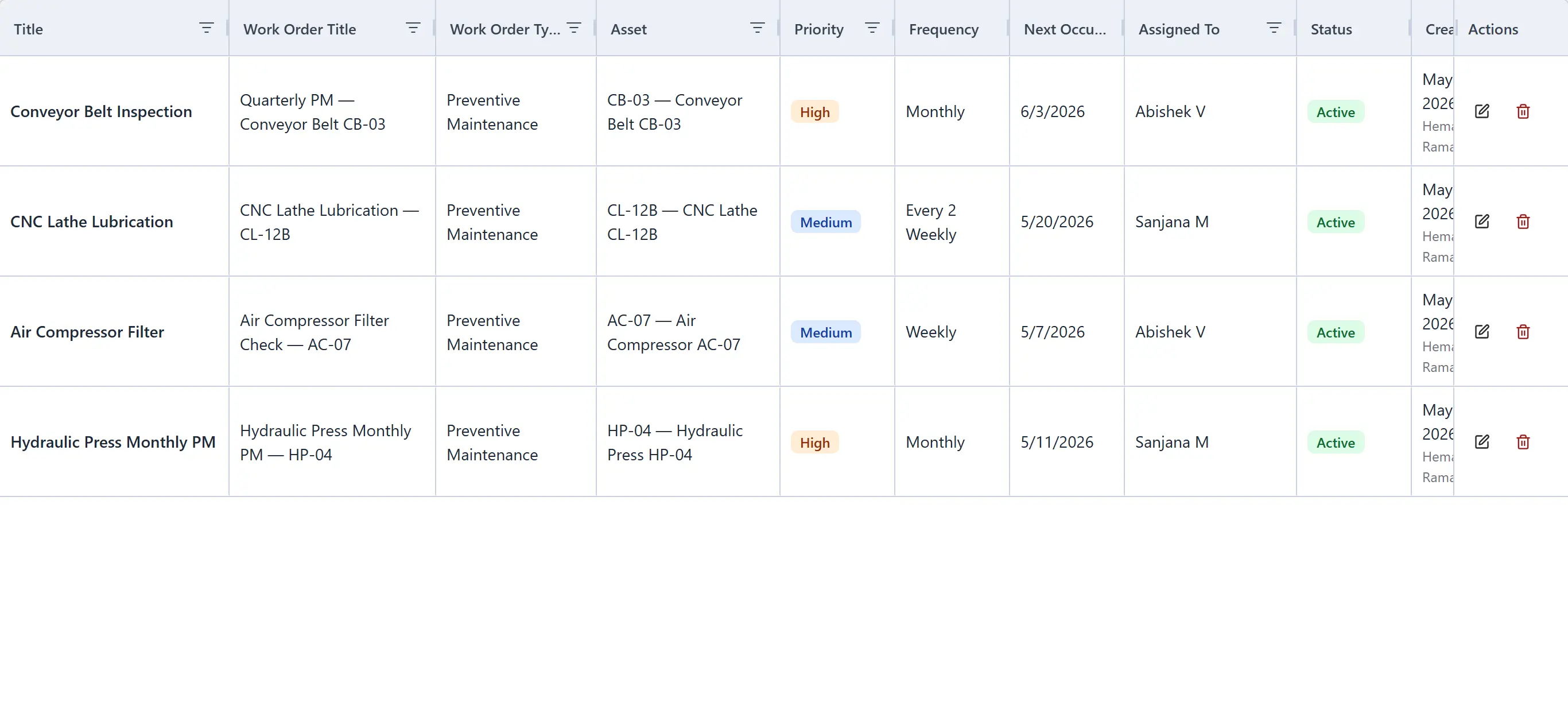
- Schedule the obvious PMs — lubrication, filters, belts — on a calendar that fires automatically.
- Track two numbers only: breakdowns per month and time-to-repair, per machine.
- After 90 days, compare. Then expand to the next line.
Where MachDatum fits: steps 3–6 are exactly what a CMMS does. Operator checklists on a phone with each step timestamped, abnormalities becoming work orders in one tap, PMs that dispatch themselves on schedule, and MTTR/MTBF per machine computed automatically from the work-order history. We're onboarding our first group of manufacturing teams right now — see how it works.